




Speed Ovens for Busy Railway Stations
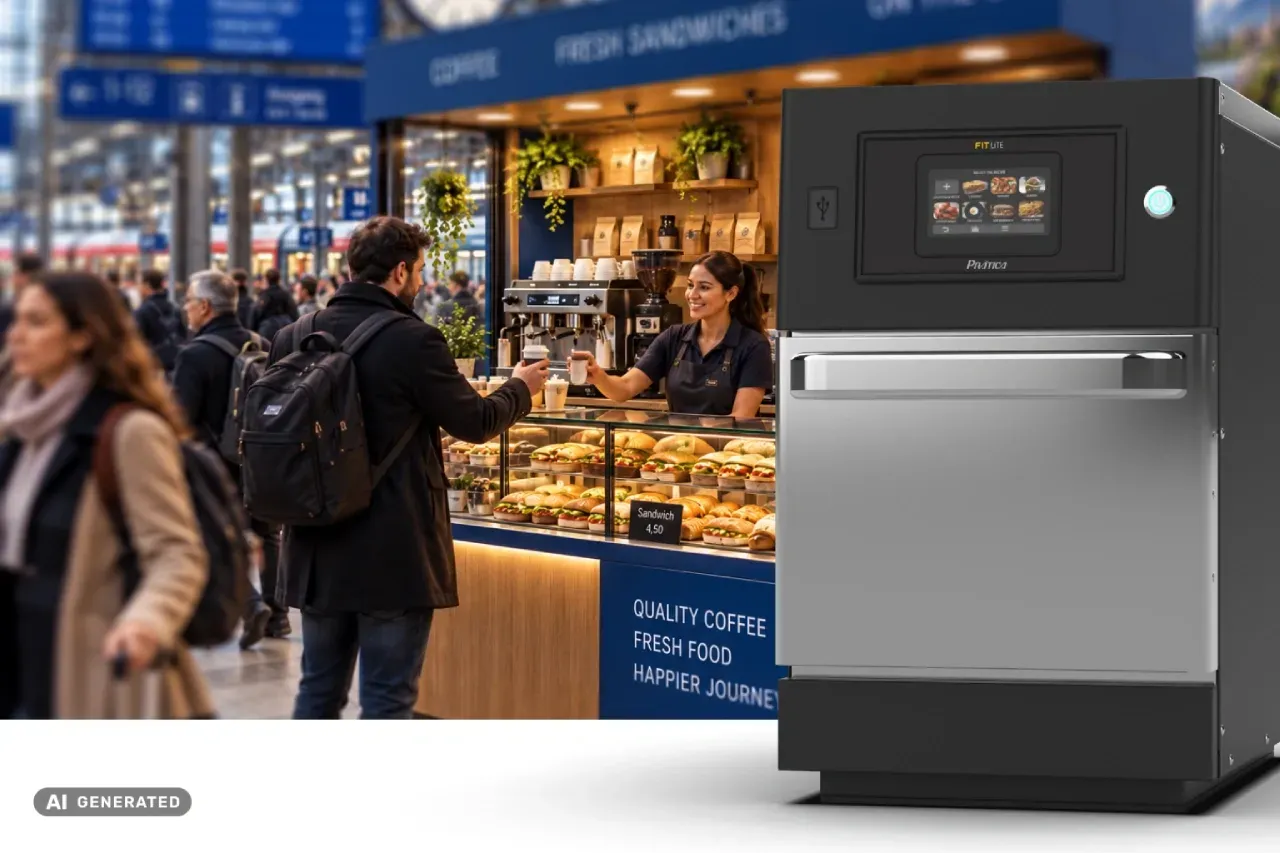
Railway station foodservice operates around passenger flow, short service windows and concentrated periods of demand.
Cafés, kiosks, convenience stores and food-to-go outlets need to serve travellers within an environment shaped by train schedules, departures and changing passenger volumes.
The commercial scale of these locations is significant.
Network Rail recorded nearly 193 million visits across its managed station portfolio during summer 2026, up 8.9% compared with summer 2024.
The organisation identifies railway stations as locations offering substantial audiences for retailers and food and beverage operators.
The role of retail within stations is also visible in the Netherlands.
NS operates more than 185 shops across its own retail formats, including AH to go, Kiosk, Station House and Julia's.
The company also operates Grab & Go vending machines at stations.
Railway food retail continues to expand elsewhere in Europe.
In France, Carrefour and Lagardère Travel Retail plan to deploy 150 food stores in railway stations by 2030.
The project, awarded by SNCF Gares & Connexions, includes Carrefour stores ranging from 80 to 400 square metres and online order pick-up points.
For foodservice businesses, high passenger footfall, changing demand and constrained commercial space create a specific operational question: how can hot food be prepared and served quickly enough for passengers travelling on a schedule?
What makes railway station foodservice different?
Railway station foodservice includes cafés, kiosks, convenience stores, takeaway counters and other concepts serving passengers within transport hubs.
Unlike businesses with relatively predictable meal periods, station outlets can be heavily influenced by train schedules, commuter movements and connections.
Several orders may arrive within minutes as passengers move through the concourse, while quieter intervals may follow between departures.
Daily sales therefore reveal only part of the capacity requirement.
What matters during equipment planning is whether the operation can process enough orders during its busiest service window.
A customer who has a train departing shortly is unlikely to evaluate waiting time in the same way as someone sitting in a restaurant.
For the outlet, cooking time becomes part of the total interval between order, payment, preparation, collection and departure for the platform.
Travel retail combines convenience with hot food
Convenience is already central to European railway retail.
NS, for example, operates station formats ranging from Kiosk to AH to go and Julia's, illustrating how retail, food-to-go and prepared food can coexist within the railway environment.
Menus can include chilled products alongside toasted sandwiches, panini, wraps, breakfast items, pastries, snacks and individual hot meals.
These categories do not all require the same production method.
Some can be sold directly from refrigerated displays.
Others benefit from final heating, browning, toasting or crisping shortly before service.
This is where the distinction between ready-to-eat and ready-to-heat food becomes operationally important.
How do Speed Ovens work in railway stations?
A commercial Speed Oven combines rapid internal heating with surface finishing in a single appliance.
Prática Speed Ovens use microwave energy and high-velocity impinged hot air.
Depending on the equipment and recipe, the process can heat the centre while producing characteristics such as browning, toasting or crispness on the surface.
A chilled sandwich, for example, may require a hot filling, melted cheese and toasted bread.
Instead of transferring it between separate appliances, compatible menu items can complete these stages within a programmed cycle.
This makes the technology relevant to railway cafés, kiosks and convenience concepts where preparation time and available workspace are both limited.
For a deeper explanation of the cooking process, see Speed Oven vs Microwave: What Is the Difference?.
Limited space changes equipment planning
pace inside a railway retail unit needs to accommodate several functions.
Depending on the concept, these may include refrigeration, frozen storage, preparation surfaces, packaging, display, payment, collection and cooking.
Countertop appliances can reduce the physical area dedicated to the cooking station, but external dimensions should never be considered independently from capacity.
A compact oven that cannot process sufficient orders during rush periods can become a bottleneck.
The relevant measurement is therefore not simply appliance footprint. It is the relationship between footprint and throughput.
This is particularly important for kiosks and small station units.
Our article Speed Ovens for Kiosks and Small Foodservice Spaces examines this relationship in greater detail.
On-demand preparation suits variable passenger flow
Passenger traffic changes according to time of day, train schedules, weekdays, weekends and local events. Disruptions can alter normal patterns even further.
This variability makes forecasting prepared hot food difficult.
Producing too much in advance can leave unsold portions.
Producing too little can create gaps in availability precisely when passenger traffic increases.
For compatible menu items, an alternative is to keep portions under appropriate refrigerated or frozen conditions and complete the final heating after the order.
This can reduce the amount of food that needs to be heated before demand is known.
It does not eliminate waste. Shelf life, stock rotation, production planning, refrigeration and food safety controls remain essential.
The differences between advance holding and finishing after an order are examined in Hot Holding vs On-Demand: Food Safety, Quality and Waste.
Programmed recipes support repeatable service
Station outlets may operate across long opening hours with different employees and shifts.
Manually deciding cooking parameters for every portion adds unnecessary variation to a process that often needs to be completed within minutes.
Stored programmes allow validated parameters to be assigned to individual menu items.
Employees select the appropriate recipe rather than determining time, microwave power and airflow independently for every order.
Programming can support repeatability between shifts and, where the operating system allows, across multiple locations.
This is particularly relevant to travel retail groups operating the same concept at several stations.
Which Speed Oven capacity does a station outlet need?
Start with the menu and busiest period rather than total daily sales.
The calculation should consider:
- product and portion dimensions;
- chilled or frozen starting condition;
- preparation time for each main item;
- portions that can be processed per cycle;
- expected orders during peak periods;
- required hourly throughput;
- available counter area;
- electrical supply;
- refrigeration and frozen storage;
- number of employees working at the station;
- expected changes in menu or volume.
A small coffee kiosk serving a restricted range of chilled snacks has different requirements from a high-footfall convenience store preparing hot food throughout the day.
Prática offers different Speed Oven configurations for these operating profiles.
The FIT Line includes models designed around different capacity, chamber and service requirements.
Stackable ovens can add capacity vertically
Some station locations face a specific problem: throughput needs to increase during commuter peaks, but there is no additional counter width available.
Stackable equipment can address this constraint by adding independent cooking capacity vertically.
Two chambers can also process different orders simultaneously rather than forcing every customer into the same cooking sequence.
The value of this configuration depends on actual demand. Adding a second chamber without sufficient order volume simply adds unused capacity.
The decision should come from peak-period calculations rather than the assumption that a busier station automatically requires a larger installation.
Test the actual railway station menu
Equipment specification should include testing with the foods the outlet intends to sell.
Preparation time alone is insufficient.
Testing should assess:
- portion dimensions;
- starting temperature;
- internal heating;
- surface browning or crispness;
- texture;
- serving condition;
- cycle duration;
- consecutive order capacity.
A recipe that performs well once also needs to remain operationally viable when several passengers order within a short interval.
Menu testing therefore connects food quality with real service capacity.
Measure orders per peak, not only orders per day
Consider two outlets that each sell 300 hot items daily.
One distributes those orders relatively evenly over its opening hours.
The other receives a large share around morning and evening commuter periods.
Their daily volume is identical, but their required throughput is not.
This distinction matters when choosing chamber size, power configuration and the number of cooking cavities.
For a detailed comparison of these variables, see Which Commercial Speed Oven Should You Choose?.
For railway foodservice, the useful capacity question is therefore:
How many suitable orders must the cooking station complete during its busiest 15, 30 and 60 minutes?
That figure provides a better basis for equipment selection than daily sales alone.
Railway foodservice follows the passenger clock
A station food outlet competes with a departure time.
Passengers need enough time to choose, order, pay, collect their food and reach the train.
The production flow has to fit within that window.
Speed Ovens can support this model when the menu requires rapid internal heating combined with surface finishing and when the selected equipment matches actual peak demand.
The equipment is only one part of the operation.
Menu design, refrigeration, food safety, workspace, staffing and order flow determine whether rapid cooking translates into rapid service.
For railway cafés, kiosks, convenience stores and food-to-go concepts, the objective is therefore not simply to cook faster. It is to match preparation capacity to passenger flow.
FAQ about Speed Ovens for railway stations
Are Speed Ovens suitable for railway station foodservice?
They can be suitable for cafés, kiosks, convenience stores and food-to-go outlets where compatible menu items require rapid heating and surface finishing.
Model selection should consider peak demand, menu, available space and site infrastructure.
What food can a railway station prepare in a Speed Oven?
pplications can include toasted sandwiches, panini, wraps, breakfast items, pastries, snacks and selected ready meals.
Suitability depends on the oven, recipe, portion size, starting temperature and required result.
Can a Speed Oven operate without an extraction hood?
Some models are designed for ventless installation under specified conditions.
Certification, application, local regulations and installation requirements must be checked for the selected equipment.
How should a railway station calculate Speed Oven capacity?
Calculate demand during the busiest service periods and compare it with preparation time, portions per cycle and available cooking capacity.
Peak throughput is a more useful specification metric than daily order volume alone.
Can on-demand preparation reduce food waste at stations?
It can reduce waste associated with heating excessive quantities before demand is known. It does not prevent losses caused by overproduction, expired stock, inadequate storage or poor inventory control.
Content reviewed by Prática’s technical team, including chefs, baking technicians, engineers and sales consultants, backed by the company’s over 35 years of expertise in the foodservice industry.
Similar challenges occur in other high-traffic foodservice environments.
See
how Speed Ovens support food hall operations across Europe, where limited kitchen space, peak demand and fast service also shape equipment decisions.