




Speed Oven vs Microwave: What Is the Difference?
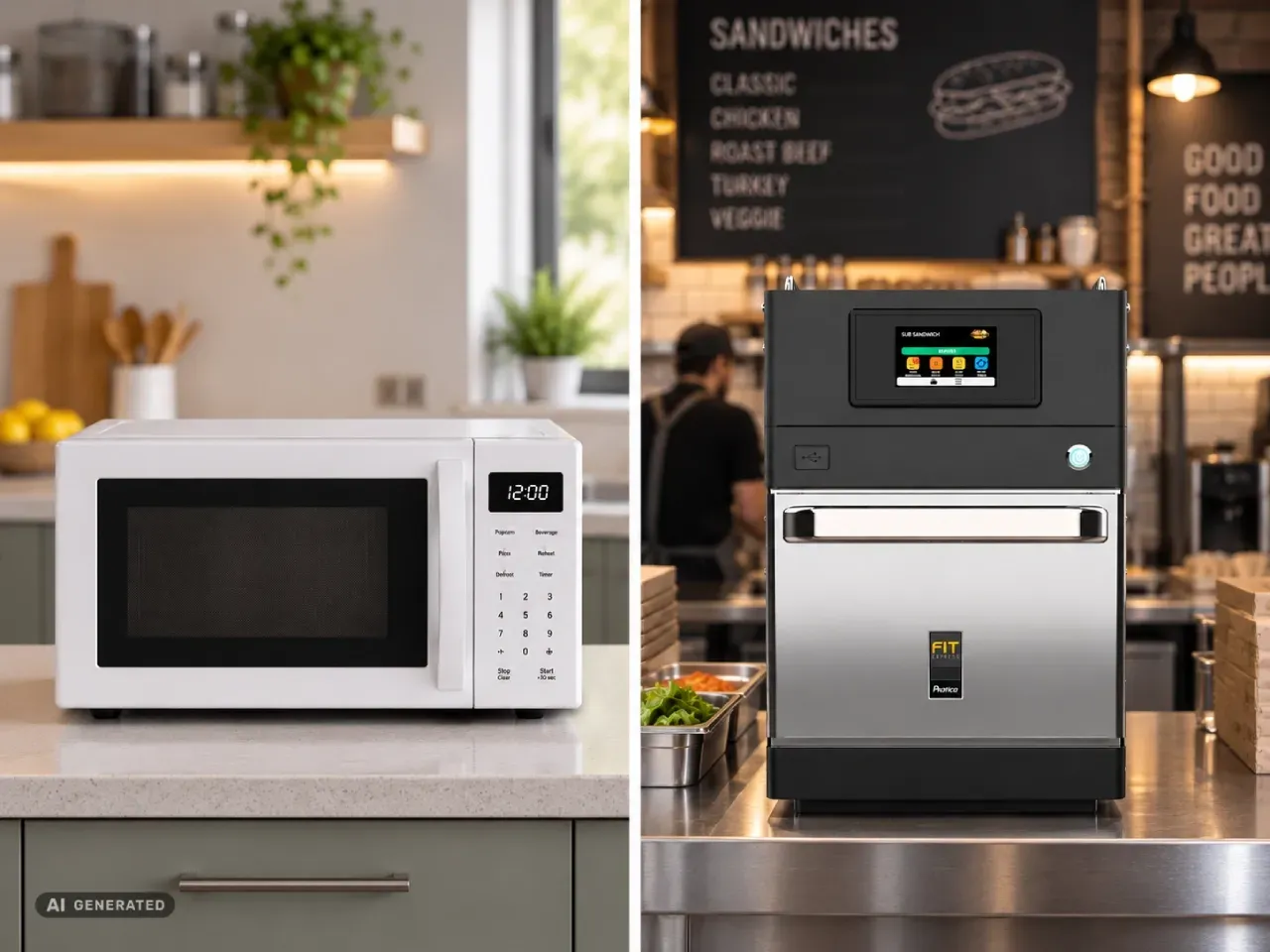
A commercial microwave and a Speed Oven can both heat food quickly, but they are designed to deliver different results.
Commercial microwaves should also be distinguished from domestic models, as professional units are built for the workload and operating conditions of foodservice environments.
A commercial microwave is often suitable when the main requirement is rapid heating, reheating, defrosting or melting.
A Speed Oven combines microwave energy with high-velocity hot air, allowing selected foods to heat quickly while also developing browning, crispness or a toasted surface.
For foodservice operators, the choice should not be based on speed alone.
Menu, expected product characteristics, service model, volume, available space and infrastructure all matter.
Understanding these differences can help determine whether a commercial microwave is sufficient or whether the operation needs the additional capabilities of a Speed Oven.
Is a Speed Oven the same as a microwave?
No. A Speed Oven is not the same as a microwave.
While both can use microwave energy, a Speed Oven combines it with other heating technologies to provide rapid internal heating and surface finishing.
Also known in the market as high-speed ovens or rapid cook ovens, these appliances can combine microwave energy, convection and impingement, depending on the equipment.
A conventional commercial microwave, by comparison, relies primarily on microwave energy.
This combination allows Speed Ovens to prepare foods that require characteristics such as toasted bread, crisp pastry or browned toppings within a fast cycle.
How does a commercial microwave work?
A microwave oven generates electromagnetic waves that interact with molecules within food, producing heat rapidly.
In commercial foodservice, microwave ovens can be useful when speed is important but browning or crispness is not required.
Depending on the food and equipment, applications can include:
- reheating selected prepared foods;
- heating soups and sauces;
- warming liquids;
- melting ingredients;
- defrosting;
- heating portions where surface texture is not a priority.
Commercial models are available in different power levels and capacities, so performance varies considerably.
Their relatively straightforward operation can suit businesses with a narrow menu and simple heating requirements.
What is the difference between domestic and commercial microwaves?
Domestic and commercial microwaves use the same basic heating principle, but they are designed for different operating conditions.
A domestic microwave is intended for household use, where heating cycles are relatively occasional.
It is not designed around the repeated workload of a professional foodservice shift.
A commercial microwave is developed for professional environments.
Depending on the model, it can offer higher power, more robust construction and controls suited to repeated use.
Programmable settings may also help employees reproduce frequently used heating cycles.
Capacity, power and duty cycle vary considerably between models.
Selection should therefore consider portion size, menu, daily use and peak demand.
The highest wattage is not necessarily the right choice.
For a professional foodservice operation, the relevant comparison is generally between a Speed Oven and a commercial microwave, rather than a household appliance.
How does a Speed Oven work?
A Speed Oven, also called a high-speed oven or rapid cook oven, is a commercial appliance that combines heating technologies to prepare selected foods quickly while also controlling surface characteristics such as browning, toasting and crispness.
In Prática Speed Ovens, microwave energy contributes to fast internal heating, while high-velocity hot air acts on the food surface.
Air impingement directs this airflow towards the product at speed.
For example, preparing a chilled sandwich may involve heating the filling, melting the cheese and toasting the bread.
A programmed Speed Oven cycle can perform these processes in the same appliance.
This capability suits made-to-order foodservice where preparation time and the final characteristics of the product both matter.
Why can Speed Ovens brown and crisp food?
Microwave energy is effective for rapid heating but does not provide the same surface effect as high-velocity hot air.
Controlled airflow transfers heat to the exterior of the food, supporting browning, toasting and moisture removal where appropriate.
This can benefit products such as:
- panini;
- toasted sandwiches;
- wraps;
- pastries;
- snacks;
- foods with browned toppings;
- selected chilled dishes.
Not every food requires these characteristics.
For soups, sauces, liquids and other suitable applications, surface browning may provide no benefit.
Which is faster: a Speed Oven or a microwave?
It depends on the food and the required result.
A commercial microwave can be extremely fast when the task is simply to heat a suitable portion.
A Speed Oven is therefore not automatically the faster choice.
The comparison changes if an item needs to be heated and then toasted, browned or crisped in another appliance. In that case, preparation time includes both stages.
A Speed Oven can carry out heating and finishing during the same cycle.
During peak periods, this can affect ticket times, queues and throughput, or the number of orders an operation can process within a given period.
For foodservice, total time from order to service can therefore be more informative than comparing individual appliance cycle times.
What foods are better suited to each oven?
The choice depends on what needs to happen to the food before it is served.
Commercial microwave
A commercial microwave can suit products where heating is the main objective, including:
- soups;
- sauces;
- liquids;
- selected ready meals;
- ingredients that need melting;
- suitable foods requiring reheating;
- selected defrosting applications.
Speed Oven
A Speed Oven can suit products that also require toasting, browning or crisping, including:
- toasted sandwiches;
- panini;
- wraps;
- pastries;
- breakfast items;
- snacks;
- selected ready meals;
- chilled prepared dishes.
Initial temperature also matters.
Chilled and frozen versions of the same product may require different programmes and preparation times.
Equipment selection should therefore begin with the actual menu rather than an assumption that one technology is better for every application.
Which offers greater menu versatility?
A Speed Oven generally offers greater menu versatility when an operation needs both rapid heating and surface finishing.
A commercial microwave may be sufficient when the menu primarily requires heating, reheating or defrosting.
A coffee shop, for example, might serve breakfast items in the morning, toasted sandwiches at lunch and snacks later in the day.
A convenience operation may need to prepare several categories of food from the same counter.
In these situations, the combination of technologies in a Speed Oven can allow one appliance to perform tasks that might otherwise require separate heating and finishing equipment.
For an operation with simpler requirements, that additional versatility may be unnecessary.
This also changes how footprint should be assessed.
The relevant question is not only how much counter space an appliance occupies, but how many pieces of equipment are required to produce the intended menu.
How do programmable recipes affect consistency?
Professional kitchens often have different employees preparing the same items across shifts.
Speed Ovens allow individual recipes to be programmed with defined preparation parameters.
Staff can select the appropriate programme rather than determine the settings for every order.
This supports repeatability and can simplify training where several products are prepared on the same appliance.
Once recipes have been defined, the same programme can be used repeatedly, reducing dependence on individual decisions during busy service periods.
What about space, power and installation?
Both commercial microwaves and Speed Ovens are available in countertop formats, but their dimensions, electrical requirements and installation conditions vary by model.
Equipment selection should consider the site as well as the menu.
Operators should consider:
- available counter space;
- electrical supply;
- required capacity;
- expected order volume;
- ventilation or extraction requirements;
- appliance location.
Some Speed Ovens are designed for ventless operation under specified conditions.
However, ventless capability should always be verified according to the individual model, application, certification and local installation requirements.
Does a Speed Oven use more energy than a microwave?
Rated power alone does not show how much energy an appliance will use in an actual foodservice operation.
Consumption depends on power, cycle duration, utilisation, number of portions, standby behaviour and the foods being prepared.
The complete workflow also matters.
If a microwave heats an item and another appliance is then required for toasting or finishing, both stages contribute to total energy use.
For this reason, energy per portion and the complete preparation process can provide a more useful comparison than wattage alone.
When does a commercial microwave make more sense?
A commercial microwave may be the appropriate choice when the business primarily needs fast heating and does not require significant surface finishing.
It can make sense when:
- reheating is the main task;
- the menu is relatively limited;
- soups, sauces or liquids are common applications;
- browning and crispness are unnecessary;
- another appliance already performs finishing;
- lower initial equipment investment is a priority.
For a straightforward heating requirement, buying capabilities that will rarely be used may add unnecessary cost.
When does a Speed Oven make more sense?
A Speed Oven can be a better fit when the menu requires several preparation processes within short service times.
Typical considerations include:
- toasted or crisp products;
- foods requiring browning;
- made-to-order preparation;
- multiple menu categories;
- short ticket times;
- programmable recipes;
- repeatability across employees or locations;
- limited space for multiple appliances.
These requirements can occur in coffee shops, bakeries, convenience stores, petrol stations, hotels, supermarkets and other food-to-go or retail foodservice operations.
How to choose for your foodservice operation
Start with the menu and define the result each item needs before reaching the customer.
For products that primarily require heating, a commercial microwave may provide everything the operation needs.
When the menu also requires processes such as toasting, browning or crisping, consider whether combining those functions within a Speed Oven could simplify the workflow.
Then evaluate volume, peak demand, portion size, counter space, electrical infrastructure, installation requirements and the number of recipes the business needs to produce.
The right choice is the equipment that matches the food, workflow and service requirements, rather than the appliance with the longest list of functions.
FAQ about Speed Ovens and microwaves
Is a Speed Oven just a powerful microwave?
No. A Speed Oven can use microwave energy, but it combines this with other heating technologies. Its capabilities therefore extend beyond simply increasing microwave power.
Is a convection microwave the same as a Speed Oven?
Not necessarily. Both may combine microwave energy and hot air, but airflow, power, controls, equipment design and intended applications can differ considerably. Specifications should be compared for the individual appliances.
Can a domestic microwave be used in a commercial kitchen?
Domestic microwaves are intended for household use rather than the repeated workload of professional foodservice.
Businesses should select equipment appropriate for their expected volume, operating conditions and applicable local requirements.
Can a Speed Oven replace a commercial microwave?
It can perform many rapid heating applications, but whether replacement makes sense depends on the menu and workflow.
If simple heating is the primary requirement, a commercial microwave may be sufficient.
A Speed Oven provides additional capabilities when other preparation processes are also required.
Can a microwave brown or crisp food?
Microwave energy alone does not provide the high-velocity surface airflow used by Speed Ovens for processes such as browning, toasting and crisping.
Some microwave appliances incorporate additional heating technologies, so capabilities should always be checked for the specific model.
Want to improve customer service?
See how Speed Ovens can help deliver faster service, consistent food quality and a smoother customer experience.