




Speed Ovens for Kiosks and Small Foodservice Spaces
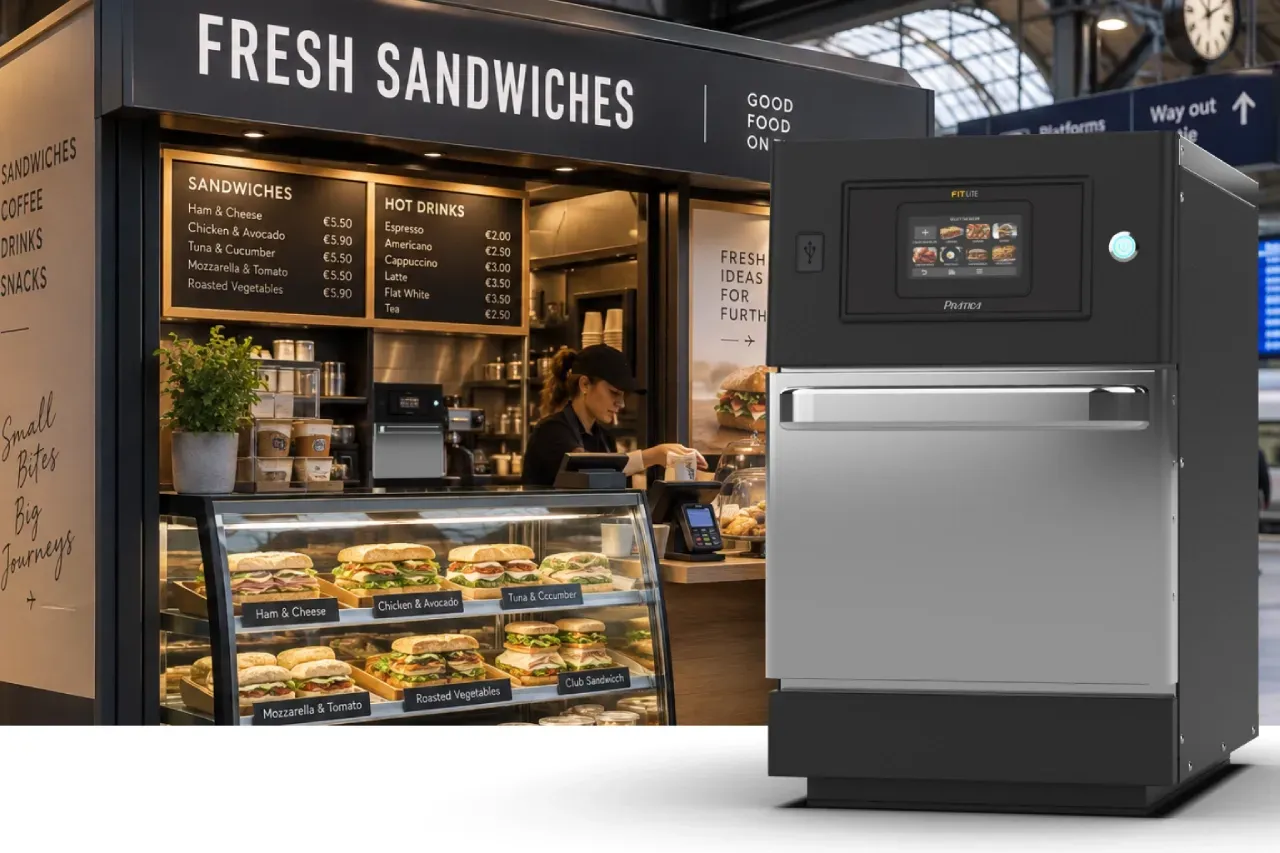
Food kiosks and compact foodservice concepts need to produce and serve food within a limited footprint.
Yet a small counter does not necessarily mean low demand.
A kiosk in a shopping centre, airport, railway station or other high-traffic location may need to handle concentrated periods of orders while offering several menu items.
Equipment selection should therefore consider the menu, workflow, peak capacity and available infrastructure, not simply appliance dimensions.
A Speed Oven can suit compact foodservice because it combines rapid heating with surface finishing in a countertop appliance.
For suitable products, heating, browning, toasting or crisping can take place within the same programmed cycle, reducing preparation stages.
What defines a compact foodservice operation?
Compact foodservice uses a limited physical area for preparation and service. Examples include:
- food kiosks;
- food court counters;
- concession stands;
- compact cafés;
- takeaway points;
- food-to-go concepts;
- retail foodservice counters.
These businesses may have little room while still processing significant order volumes during peak periods.
The available area must accommodate cooking, refrigeration, storage, preparation, packaging, ordering and collection.
Layout should allow staff to move efficiently between these functions.
This makes the relationship between footprint and production capacity central to equipment planning.
Why does equipment footprint matter in a kiosk?
Every appliance competes for counter or floor area that could be used for another part of the operation.
External dimensions alone, however, do not indicate whether a piece of equipment is suitable. Its functions and capacity also need to match the products being sold.
If a menu item must be heated in one appliance and toasted in another, both processes require room.
For suitable foods, a Speed Oven can perform internal heating and surface finishing during one cycle.
The objective is therefore to make effective use of the available footprint without compromising the required output.
How can a Speed Oven fit into a small workspace?
A Speed Oven, also called a high-speed oven or rapid cook oven, is a commercial appliance that combines heating technologies to prepare selected foods quickly while controlling surface characteristics such as browning, toasting and crispness.
In Prática Speed Ovens, microwave energy contributes to rapid internal heating, while high-velocity hot air acts on the food surface.
Air impingement directs this airflow towards the product.
A chilled sandwich, for example, may need its filling heated, cheese melted and bread toasted.
A programmed cycle can perform these processes in the same appliance.
This combination can be useful where both preparation time and counter availability are limited.
What can a kiosk prepare in a Speed Oven?
Applications depend on the oven, recipe, portion and starting condition of the food.
They can include:
- toasted sandwiches;
- panini;
- wraps;
- pastries;
- breakfast items;
- snacks;
- selected chilled products;
- selected frozen products;
- selected ready meals.
This range can support different menu categories throughout the day.
A café counter might serve breakfast items in the morning, sandwiches at lunchtime and snacks later on.
Each product can require its own programme according to ingredients, portion, initial temperature and intended result.
Menu versatility does not mean applying the same cycle to different foods.
Why should the menu come before the equipment?
Each menu item has consequences beyond cooking.
New products may require additional ingredients, refrigeration, dry storage, packaging or preparation.
A menu can therefore become difficult to execute even when the cooking appliance is technically capable of preparing every item.
Before selecting an oven, map each product against its preparation requirements:
- Does it need heating only?
- Does it require browning, toasting or crisping?
- Can ingredients be shared between products?
- What refrigerated and dry storage is required?
- How many preparation steps occur before cooking?
- Which items are likely to be ordered simultaneously?
This analysis helps determine the functions and capacity the business actually needs.
Can a Speed Oven be installed front-of-house?
Yes, provided the selected model and installation conditions are appropriate for the intended location.
This can be useful in kiosks, where food preparation and customer service often share the same counter environment.
A front-of-house installation should account for appliance dimensions, access, heat, noise, cleaning routines and employee movement.
Loading and unloading should not interfere with ordering, payment or collection.
The position of the oven should follow the service flow rather than being determined only by where it physically fits.
What infrastructure does a Speed Oven require?
Requirements vary by model and should be checked before equipment is specified.
Relevant factors include:
- electrical supply;
- voltage and power requirements;
- counter dimensions;
- equipment weight;
- required clearances;
- ventilation or extraction conditions;
- installation location;
- connectivity, where applicable.
These considerations can be decisive when a kiosk occupies an existing retail or transport site where electrical or ventilation modifications may be difficult.
Some Speed Ovens are designed for ventless operation under specified conditions, which can create installation possibilities where conventional extraction is difficult to provide.
Ventless capability is not universal. The selected model, application, certification and local installation requirements must be checked individually.
How should a kiosk plan for peak demand?
Average daily sales can hide the capacity required during the busiest part of the day.
If a large share of orders arrives within a short lunchtime period, an oven may handle the total daily volume but still create queues during that interval.
Capacity planning should consider:
peak orders → portions per cycle → cycle time → required throughput
Menu mix also affects output because products may have different programmes and preparation times.
Representative menu items should therefore be tested against expected peak volumes.
This provides a more useful basis for selection than chamber size or rated power alone.
When can stacking Speed Ovens make sense?
Stacking can increase cooking capacity while using vertical rather than additional horizontal space.
It can be considered when a business needs:
- more capacity during peak periods;
- simultaneous preparation of different orders;
- different programmes running at the same time;
- higher throughput without substantially expanding counter footprint.
Additional ovens also increase electrical demand and can affect heat load, workflow and investment.
Stacking should therefore respond to measured or expected service volume rather than unused theoretical capacity.
The Prática FIT ST is designed for stacked configurations where this approach matches production requirements.
Which Speed Oven is suitable for a kiosk?
Selection should reflect product dimensions, menu profile, peak demand and site infrastructure rather than simply choosing the smallest available model.
Within the Prática Speed Ovens range, different configurations address different requirements.
The FIT Lite is positioned for snack-led operations with consistent daily volumes, particularly where refrigerated and pre-prepared foods form the core of the menu.
Its 230 V single-phase configuration can also be relevant when assessing compatibility with the electrical supply available at the site. It is not recommended for frozen food operations.
The FIT SM is positioned for menu expansion and incorporates a full catalytic system and moisture management.
The FIT Express provides a versatile configuration for a broader range of foodservice applications.
Where product dimensions or capacity requirements increase, the larger chamber of the FIT XL can be considered.
If horizontal counter area is restricted but greater output is required, the stackable FIT ST provides another configuration to evaluate.
The appropriate model depends on what will be prepared, how often it will be ordered and the conditions at the installation site.
Can a kiosk operate with only a Speed Oven?
It depends on the menu and service model.
A Speed Oven can combine several preparation processes for suitable foods, but a kiosk may still require refrigeration, storage, preparation surfaces, sinks, packaging areas, display equipment, point-of-sale systems and other appliances.
Rather than asking whether one oven can replace an entire kitchen, operators should identify which preparation stages can realistically be combined.
For selected menus, integrating rapid heating and surface finishing in one appliance can simplify the production flow and reduce dependence on separate cooking equipment.
How to choose a Speed Oven for a kiosk
Start with the menu and define the required result for each product.
Then calculate demand during the busiest service period rather than relying only on daily sales.
Compare those requirements with:
- product and portion dimensions;
- chilled or frozen starting condition;
- portions per cycle;
- preparation time;
- peak order volume;
- required throughput;
- counter dimensions;
- electrical supply;
- installation conditions;
- front-of-house positioning;
- expected capacity growth.
The final specification should connect three elements: what the kiosk serves, how much it needs to produce at peak times and what the site can support.
FAQ about Speed Ovens for kiosks
Can a Speed Oven be used in a food kiosk?
Yes. The model should be selected according to the menu, required capacity, available footprint and site infrastructure.
How much counter space does a Speed Oven need?
Dimensions and required clearances vary by model.
The layout should also provide enough working area for employees to load, unload and operate the appliance without obstructing other service activities.
Can one Speed Oven prepare different menu items?
Yes. Individual programmes can be created for suitable products with different preparation parameters.
The available range depends on the oven, food characteristics, portion size and intended result.
Can two Speed Ovens be stacked in a small kitchen?
Models designed for stacking can use vertical space to increase capacity.
Before choosing this configuration, operators should evaluate electrical requirements, installation conditions, workflow and peak demand.
Not sure which model fits your operation? Read our article to find out.