




Which Commercial Speed Oven Should You Choose?
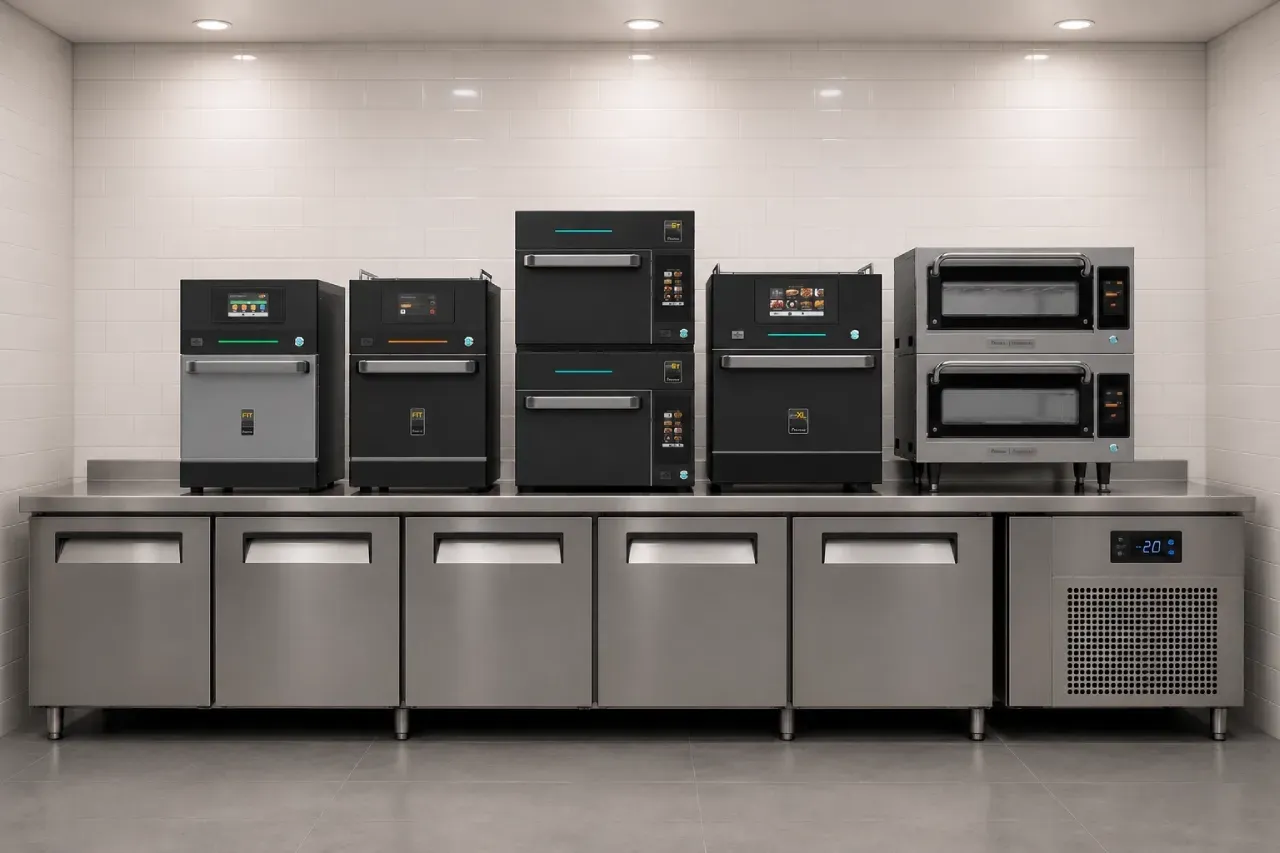
Choosing a Commercial Speed Oven becomes easier when the decision starts with the menu, service volume and available infrastructure.
Product size, starting temperature, peak-hour demand, electrical supply, countertop space and recipe management all influence which model is most suitable.
A small café serving refrigerated snacks has very different requirements from a busy travel location preparing frozen products throughout the day.
Likewise, a pizza-led operation requires a different cooking system from a convenience store serving sandwiches, ready meals and food-to-go products.
Prática offers several Speed Oven configurations designed for different workloads and menu requirements.
Which Prática Speed Oven should you choose?
- FIT Lite suits lower-demand businesses working mainly with chilled and pre-prepared foods.
- FIT SM combines a Single Mag configuration with IoK connectivity and is relevant where electrical capacity is limited.
- FIT Express is suited to broader menus, including chilled and frozen products, and regular to intensive service.
- FIT XL offers a larger chamber for bigger products or several portions per cycle.
- FIT ST is designed for demanding service where two independent stacked ovens can prepare different orders simultaneously.
- Forza STi uses high-speed impinged air without microwave energy and is intended primarily for pizzas and similar products.
These are starting points. The final selection should always consider the actual menu, hourly throughput and installation requirements.
Start with the food you need to prepare
Food characteristics should be one of the first selection criteria.
Consider:
- typical product dimensions;
- chilled, refrigerated or frozen starting temperatures;
- average portion size;
- products prepared during the busiest service period;
- number of portions required per cycle;
- variety of orders arriving at the same time.
A 30 cm sandwich and a 40 cm pizza place different demands on chamber capacity.
Preparing one refrigerated snack at a time is also very different from handling several frozen or substantial menu items during a busy lunch period.
Once these variables are defined, comparing models becomes considerably easier.
FIT Lite: for lower-demand foodservice businesses
The FIT Lite is an entry-level option for smaller businesses adopting Speed Oven technology.
It uses one 1,100 W magnetron and operates on a 230 V single-phase electrical supply.
Its compact 386 mm width makes it suitable for locations where countertop space and available electrical capacity are limited.
The oven is intended primarily for refrigerated and pre-prepared foods, including sandwiches, savoury pastries, pre-baked items, pasta, lasagne and similar foods.
It is not recommended for operations where frozen products form an important part of the menu.
When does FIT Lite make sense?
FIT Lite may suit:
- small cafés;
- coffee shops;
- convenience concepts;
- compact food-to-go counters;
- smaller retail foodservice businesses;
- locations adding a limited hot-food offer;
- businesses starting to use Speed Oven technology.
The model uses USB to transfer recipes, groups, settings and software. It does not provide the remote IoK connectivity available on other models.
For a single location with a relatively simple menu, USB management may be sufficient.
Best suited to: lower-demand businesses preparing mainly refrigerated and pre-prepared foods.
FIT SM: Single Mag with IoK connectivity
FIT SM is also based on a single 1,100 W magnetron and operates on a 230 V single-phase supply.
This configuration is useful where installing equipment with higher electrical requirements would be difficult or costly.
The main difference compared with FIT Lite is connectivity.
FIT SM can connect to Prática's IoK platform through Wi-Fi or a wired RJ45 connection.
Recipes, groups and settings can therefore be managed remotely.
Its chamber accommodates products up to approximately 30 cm and supports items such as refrigerated foods, sandwiches, pre-baked products, pasta, lasagne and similar menu items.
When does FIT SM make sense?
It can suit:
- cafés;
- coffee shop chains;
- convenience stores;
- bakery retail counters;
- hotel foodservice points;
- compact multi-site businesses;
- locations with limited electrical capacity that require remote recipe management.
A dual-magnetron oven is not necessary for every business.
When the menu consists mainly of refrigerated snacks and individual portions, a Single Mag configuration may already provide suitable capacity.
Best suited to: compact businesses that require IoK connectivity without moving to a dual-magnetron configuration.
FIT Express: a versatile option for varied menus
FIT Express moves into a higher-capacity configuration with two 1,100 W magnetrons.
It combines microwave energy with impinged air to heat, brown, toast and finish foods rapidly.
The additional microwave capacity is useful for denser foods, larger portions, frozen products and busier service periods.
FIT Express can handle a varied menu that includes chilled and frozen foods, paninis, substantial sandwiches, pizzas and other prepared items.
Despite this capacity, the oven is only 386 mm wide, which makes it especially relevant where countertop width is limited.
When does FIT Express make sense?
FIT Express is suited to:
- busy cafés;
- coffee shop chains;
- petrol station foodservice;
- railway and airport foodservice;
- hotel cafés;
- grab-and-go concepts;
- retail foodservice;
- convenience stores.
It is a strong general-purpose option when the menu contains different products with different heating, browning and finishing requirements.
The model also provides IoK connectivity for remote recipe and equipment management.
Electrical supply must be checked against the relevant specification sheet before installation.
Best suited to: compact foodservice businesses with varied menus, chilled and frozen foods and regular to intensive demand.
FIT XL: for larger products and higher cycle capacity
FIT XL is designed for businesses where chamber size becomes an important factor.
Its larger cooking chamber accommodates products up to approximately 40 cm and can prepare larger items or several portions during the same cycle.
Examples include a 40 cm pizza, longer sandwiches and several smaller products prepared together.
This can increase hourly output without relying solely on shorter cooking times.
When does FIT XL make sense?
FIT XL may suit:
- high-volume foodservice;
- busy convenience locations;
- travel hubs;
- larger retail foodservice counters;
- businesses selling long sandwiches;
- operations preparing substantial filled products;
- locations that benefit from several portions per cycle.
It uses two 1,100 W magnetrons and provides IoK connectivity.
The trade-off is space. At approximately 488 mm wide, FIT XL requires a larger countertop area than FIT Express.
If menu items fit comfortably inside FIT Express and its cycle capacity meets demand, the smaller footprint may be preferable. If product size or batch quantity is the bottleneck, FIT XL becomes the stronger option.
Best suited to: businesses where larger products or greater quantities per cycle justify a larger chamber.
FIT ST: for simultaneous orders during peak periods
Some foodservice bottlenecks are caused by order variety rather than product size.
FIT ST addresses this with a stackable configuration.
Two FIT ST ovens can be installed vertically, creating two independent cooking chambers within essentially the same countertop footprint.
This allows different recipes to run at the same time.
For example, one oven can prepare a frozen menu item while the other handles sandwiches requiring a different programme.
When does FIT ST make sense?
FIT ST is particularly suitable for:
- high-volume cafés;
- busy convenience stores;
- transport hubs;
- hotel foodservice;
- retail foodservice;
- multi-site restaurant concepts;
- locations with concentrated peak periods;
- menus with many different orders arriving simultaneously.
Its main advantage is parallel production.
FIT ST is available in Single Mag and Double Mag configurations, allowing the equipment to be matched more closely to menu requirements and electrical capacity.
It also supports IoK connectivity.
Best suited to: intensive service where simultaneous orders create production bottlenecks.
Forza STi: designed for pizza-focused menus
Forza STi operates differently from the FIT range.
Instead of combining microwave energy with impinged air, it uses high-speed impinged air without microwaves.
This makes it suitable for pizzas and similar products where rapid baking and controlled hot-air movement are the main requirements.
The oven reaches temperatures up to 330°C and provides independent upper and lower temperature adjustment.
It accommodates pizzas up to approximately 40 cm and can work with fresh raw dough, frozen products and pre-baked pizzas.
Other compatible applications can include flatbreads, bruschettas, empanadas and foods with similar baking characteristics.
When does Forza STi make sense?
It may suit:
- pizzerias;
- pizza-led food-to-go concepts;
- restaurants adding pizza to the menu;
- convenience businesses with a substantial pizza offer;
- hotel foodservice;
- bars and casual dining concepts.
Forza STi can also be stacked in a 1+1 configuration and provides IoK connectivity.
Best suited to: businesses where pizza and similar products are a central menu category and microwave-assisted cooking is not required.
FIT Express, FIT XL or FIT ST?
These three models solve different production problems.
Choose FIT Express when you need a compact, versatile Speed Oven for a varied menu and regular to intensive demand.
Choose FIT XL when larger food dimensions or greater quantities per cycle are the main requirement.
Choose FIT ST when several different orders need to be prepared at the same time during busy service periods.
The distinction matters because a larger chamber does not necessarily solve a queue caused by different recipes.
Likewise, two stacked ovens may be unnecessary when the main issue is simply accommodating a larger product.
Identify the bottleneck first, then select the configuration.
Single Mag or Dual Mag?
The number of magnetrons should be evaluated according to the menu, workload and electrical installation.
Single Mag configurations can be suitable for refrigerated foods, snacks, smaller portions and lower service volumes.
They may also be easier to install in locations with limited available electrical capacity.
Dual Mag models provide greater microwave power for denser foods, larger portions, frozen products and more demanding service periods.
The most relevant combination is:
product characteristics + service volume + electrical capacity
Specifying additional power without a corresponding operational need can add unnecessary installation requirements. Insufficient capacity, however, can increase cooking times and create queues during peak periods.
IoK connectivity and multi-site foodservice
FIT SM, FIT Express, FIT XL, FIT ST and Forza STi can connect to Prática's IoK platform.
Remote management is especially useful for chains and multi-site businesses because recipes, groups, settings and software can be managed across connected equipment.
For example, a foodservice brand introducing a new sandwich across several locations can manage the cooking programme centrally instead of relying entirely on local configuration.
This capability is relevant to:
- coffee shop chains;
- hotel groups;
- convenience networks;
- petrol station networks;
- retail foodservice groups;
- contract catering businesses.
FIT Lite uses USB transfer rather than remote IoK connectivity.
For one small location, this may be sufficient. As the number of sites grows, remote recipe management can become considerably more valuable.
Check electrical requirements before purchasing
Electrical compatibility should be confirmed before the equipment is ordered.
FIT Lite and FIT SM operate with a 230 V single-phase supply and one magnetron.
FIT Express and FIT XL use dual magnetrons and are available in electrical configurations that include 230 V single-phase and 380 V or 400 V multi-phase options.
FIT ST offers Single Mag and Double Mag configurations.
Voltage, amperage, circuit protection, socket requirements and installation conditions must always be checked against the current specification sheet for the selected model and local electrical regulations.
This is particularly relevant when fitting equipment into an existing café, convenience store or retail location where electrical upgrades could increase installation cost.
Consider ventilation requirements
Ventilation should also be checked during installation planning.
FIT SM, FIT Express, FIT XL and FIT ST incorporate catalytic systems and are specified as certified ventless models.
Forza STi also incorporates a ventless system.
FIT Lite uses a removable catalytic filtration system, but its configuration should not be treated as equivalent to the certified ventless models.
Local building, ventilation and fire requirements must always be verified before installation.
Ventless status applies to the oven itself. Other commercial kitchen equipment nearby may still require mechanical extraction.
Size the oven for peak-hour throughput
Daily sales do not always reveal the real capacity requirement.
Two cafés may each sell 100 heated food items per day.
One may sell them steadily over ten hours, while the other handles almost half of its demand between midday and 14:00.
Their daily volume is similar, but their peak-hour requirements are very different.
To estimate the necessary cooking capacity, evaluate:
- orders requiring oven preparation during the busiest hour;
- menu items ordered most frequently;
- typical cooking time for each item;
- portions that can be prepared per cycle;
- how often different recipes need to run simultaneously;
- expected growth in customer volume.
This gives a more useful picture of hourly throughput than average daily sales.
A quick way to narrow the choice
For a small snack-led business using mainly refrigerated foods, evaluate FIT Lite.
For a compact location requiring Single Mag and IoK connectivity, evaluate FIT SM.
For a general foodservice business with chilled and frozen products, evaluate FIT Express.
For larger foods or several portions per cycle, evaluate FIT XL.
For intensive peak periods with different orders arriving simultaneously, evaluate FIT ST.
For pizza and similar products prepared with high-speed impinged air, evaluate Forza STi.
These recommendations should be followed by menu testing and a technical installation assessment.
Test the oven with your actual menu
Specification sheets provide dimensions, electrical requirements and technical capabilities, but actual food performance depends on several variables.
Product density, filling quantity, moisture, fat content, thickness, starting temperature and desired texture can all affect results.
Whenever possible, test the oven with the foods, portion sizes and starting temperatures used by your business.
Include the largest, densest and most demanding menu items.
Evaluate:
- cooking time;
- internal temperature;
- browning;
- crispness;
- moisture retention;
- portions per cycle;
- realistic hourly throughput;
- ease of loading and unloading.
Testing provides a better basis for calculating cooking capacity, installation needs and return on investment than specifications alone.
Match Speed Oven capacity to your operation
There is no single Commercial Speed Oven configuration suitable for every foodservice business.
For this reason, specifications should not be the only factor in the decision.
Seeing the equipment in operation and testing representative menu items can provide a clearer understanding of cooking performance, capacity and workflow.
Prática works with a network of dealers across more than 60 countries.
Many have demonstration facilities with operating ovens, allowing customers to see different models in use, attend equipment demonstrations and, where available, test their own products before selecting a Commercial Speed Oven.
Local chefs and trained teams can also assess the requirements of each foodservice operation.
They can consider menu items, portion sizes, starting temperatures, peak-hour volumes and installation conditions when helping customers compare suitable models.
Testing actual menu items is particularly useful when evaluating cooking times, food quality and realistic hourly throughput.
See Prática Speed Ovens at foodservice trade fairs
Prática exhibits Commercial Speed Ovens and other professional foodservice equipment at trade fairs and industry events across Europe and other international markets.
These exhibitions allow foodservice operators to see the equipment in operation, discuss menu requirements with specialists and compare models for different applications.
Prática at European foodservice trade fairs
Across Europe, Prática and its local dealers participate in major foodservice, hospitality, retail and bakery exhibitions.
These include
- Host Milano in Italy,
- IBA,
- EuroGastro in Warsaw,
- Gastro Helsinki,
- EuroShop,
- SIGEP in Rimini,
- Sirha Bake & Snack in France,
- Sirha Budapest, SIHRE Sofia,
- Interfood Bulgaria,
- Horecava Amsterdam
- EXPO Gent in Belgium.
Prática at international foodservice exhibitions
Prática and its local partners also exhibit at events in other markets, including
See and test Speed Ovens before choosing a model
Trade fairs provide a useful opportunity to see Commercial Speed Ovens working under demonstration conditions.
Operators can discuss product size, menu composition, expected throughput, peak-hour demand and installation requirements with local specialists before comparing suitable configurations.
For businesses unable to attend an exhibition, Prática's dealer network provides another route to equipment demonstrations.
Contact your local Prática dealer to check model availability, arrange a demonstration and ask whether you can test representative products from your own menu before selecting a Speed Oven.
Frequently Asked Questions
Which Prática Speed Oven is best for a small café?
FIT Lite can be a suitable starting point for a smaller café preparing mainly refrigerated snacks and pre-prepared foods.
FIT SM should be considered when IoK connectivity is required.
What is the difference between FIT Lite and FIT SM?
Both use a single 1,100 W magnetron and a 230 V single-phase electrical supply.
FIT Lite uses USB for recipe and software transfer, while FIT SM provides IoK connectivity for remote recipe management.
What is the difference between FIT Express and FIT XL?
FIT Express provides a compact dual-magnetron configuration for varied menus, including chilled and frozen products.
FIT XL offers a larger chamber for bigger foods or greater quantities per cycle.
When should I choose FIT ST?
FIT ST is useful when high peak-hour demand requires different recipes to be prepared simultaneously.
Two ovens can be stacked to provide independent cooking chambers within the same countertop footprint.
Can FIT Lite prepare frozen products?
FIT Lite is not recommended for operations where frozen foods are an important part of the menu.
Another FIT model should be evaluated for significant frozen-food preparation.
Does Forza STi use microwaves?
No. Forza STi uses high-speed impinged air without microwave energy and is intended primarily for pizzas and foods with similar baking requirements.
Do all Prática Speed Ovens connect to IoK?
No. FIT SM, FIT Express, FIT XL, FIT ST and Forza STi provide IoK connectivity. FIT Lite uses USB transfer for recipes, settings and software.
Learn what to consider when choosing the right Commercial Speed Oven for your foodservice operation.