




Hotel Foodservice Solutions: Speed Ovens and Room Service
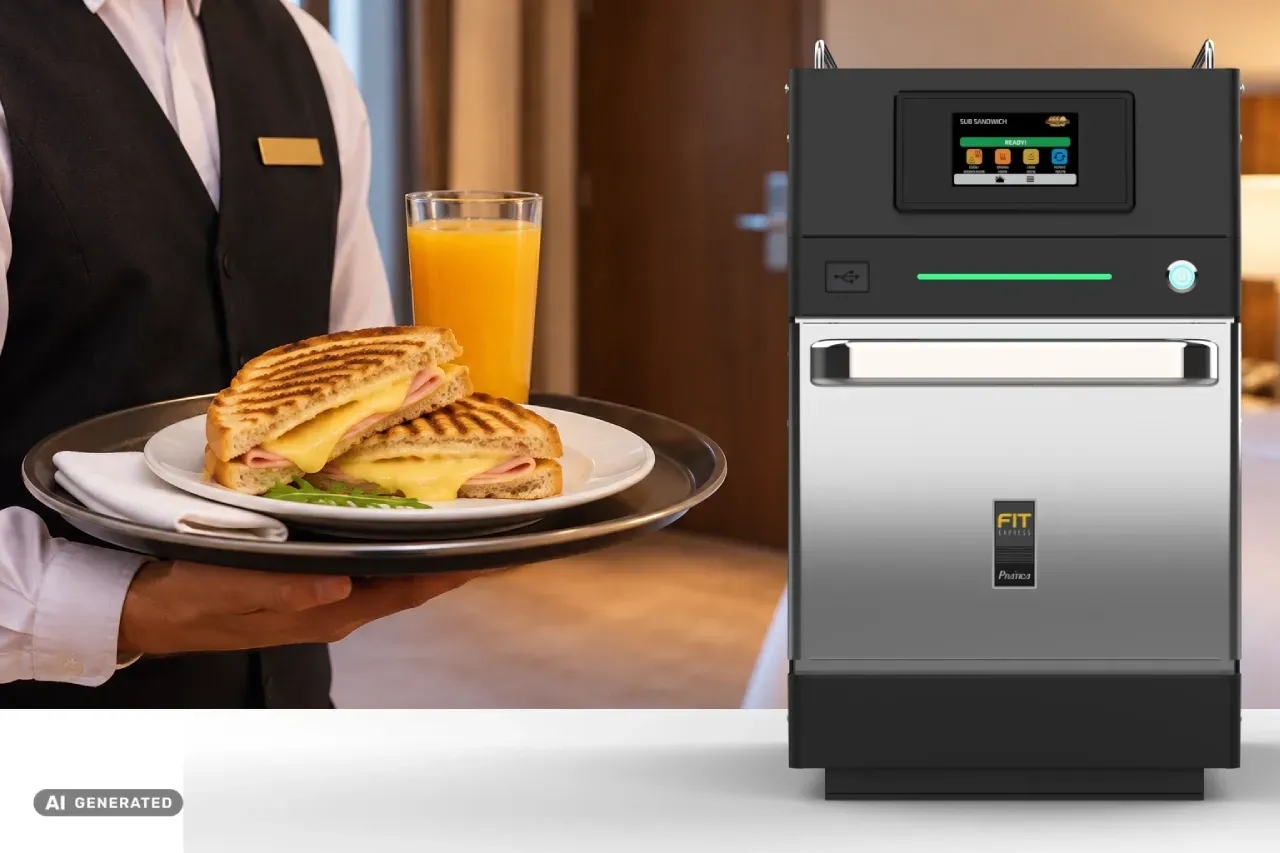
Hotel foodservice presents a particular challenge: guests may want a hot meal at almost any time, while demand can vary considerably throughout the day.
Maintaining a fully staffed kitchen for occasional orders is not always financially viable, particularly in smaller hotels and properties with limited dining facilities.
Speed Ovens offer another way to organise selected foodservice operations. By finishing suitable prepared foods on demand, hotels can serve hot sandwiches, pizzas, savoury pastries and other menu items without preparing every component from scratch when an order arrives.
For hotel managers and food and beverage (F&B) operators, the opportunity extends beyond faster cooking.
A well-designed food offer can generate additional revenue, make better use of existing spaces and give guests access to meals outside conventional restaurant hours.
The right approach depends on the property's size, location, guest profile and available staff.
A city hotel, airport hotel and boutique property may all benefit from flexible foodservice, but they will not necessarily need the same menu or equipment.
What Are the Main Challenges in Hotel Foodservice?
Unlike a busy restaurant with relatively predictable lunch and dinner periods, a hotel may receive food orders throughout the day and evening.
Guests arriving after a delayed flight might want dinner at 23:00.
Business travellers may need breakfast before the main restaurant opens. Others may prefer a light meal in the lounge rather than a full restaurant service.
These situations create several operational challenges:
- Unpredictable demand across different service periods.
- Labour costs associated with extended opening hours.
- Limited kitchen space in smaller properties.
- Food waste when prepared products remain unsold.
- Maintaining consistent food quality across shifts.
- Delivering meals promptly without complicating workflows.
- Generating sufficient revenue to justify the service.
he challenge is not simply to cook faster. Hotels need to match their food offer to actual demand while controlling the resources required to provide it.
For some properties, this means maintaining a full restaurant.
For others, a compact menu supported by suitable finishing equipment may provide a commercially viable alternative.
How Can Speed Ovens Improve Hotel Foodservice?
Speed Ovens are commercial appliances designed to cook or finish compatible foods rapidly using controlled heating technologies.
Depending on the model, they may combine microwave energy with high-speed hot air or use other heating configurations to achieve the required result.
Microwave-assisted models can heat the interior of suitable foods while high-speed air helps develop surface colour and texture.
This makes them useful for products that need to be hot inside while retaining a toasted or crisp exterior.
Pizza-focused models use different heating arrangements to develop the crust and finish toppings.
The distinction matters because not every Speed Oven is intended for the same menu or production volume.
Finishing Prepared Food When Guests Order
One of the main advantages for hotels is the ability to separate much of the preparation from the final service stage.
Instead of assembling and cooking every item from the beginning, staff can work with suitable portioned, chilled, frozen or partially prepared products.
When an order arrives, the selected item is finished using an established cooking programme.
Potential applications include:
- Toasted sandwiches and panini.
- Filled focaccia and savoury croissants.
- Individual pizzas and pizza slices.
- Quiches and savoury pastries.
- Selected prepared dishes suitable for rapid reheating.
- Warm bakery products and compatible desserts.
Each product must be tested with the intended oven. Portion size, starting temperature, moisture content and packaging can all affect the finished result.
For hotels, the benefit is a simpler service process that can reduce the number of preparation steps required when guests place orders.
Consistent Results Across Different Shifts
Hotels frequently operate with different employees covering breakfast, afternoon and evening service.
When food preparation relies heavily on individual judgement, results may vary between shifts.
Programmable Speed Ovens allow operators to establish cooking settings for specific menu items.
Once tested, these programmes can be used by trained staff to reproduce the intended heating conditions.
Standardised programmes do not eliminate the need for consistent ingredients and portions.
However, they can reduce unnecessary adjustments and make routine food finishing easier to manage.
For a closer look at how programmable equipment can support teams working with limited resources, read Fewer Staff, Busy Kitchen: Can Speed Ovens Help?
Can Hotels Offer Room Service Without a Full Kitchen?
Yes, selected room service menus can be organised without operating a full restaurant kitchen throughout every service period.
This approach is particularly relevant to hotels where evening or overnight demand is too low to justify maintaining a complete kitchen team.
The solution begins with the menu rather than the equipment.
A smaller selection of products that can be prepared consistently is often easier to manage than an extensive menu requiring several cooking methods.
Designing a Compact Room Service Menu
A limited menu should reflect what guests are likely to order, how the products travel to guest rooms and how much preparation is required.
For example, an evening menu might include:
- Margherita pizza or another individual pizza option.
- Ham and cheese panini.
- Vegetable focaccia with melted cheese.
- Quiche with a separately prepared salad.
- A suitable prepared hot dish.
- A chilled dessert requiring no final cooking.
hese items do not all need to use the same equipment.
The menu should be developed around the hotel's available facilities and the capabilities of the selected Speed Oven.
Using ingredients across several products can also simplify purchasing and stock management.
Cheese, vegetables and selected fillings may appear in sandwiches, focaccia and pizzas without requiring completely separate ingredient inventories.
Planning Late-Night Room Service
Late-night foodservice requires particular attention to workflow.
Guests may place orders infrequently, but they still expect clear information about availability and delivery times.
Hotels should establish who receives orders, who finishes the food and how meals are delivered to rooms.
Where the operation allows, a compact finishing station can support a limited overnight menu without keeping the main restaurant open.
However, an oven's cooking cycle is only one part of the service time.
Order processing, preparation, packaging, collection and delivery must also be considered.
A hotel should therefore calculate realistic delivery times rather than advertising a service based solely on the speed of the appliance.
How Can Hotels Generate Revenue from Grab-and-Go Food?
Grab-and-go foodservice provides an alternative to conventional restaurant dining.
Guests can purchase selected products from a lobby shop, café or dedicated convenience area, often without booking a table or waiting for a full meal service.
The format can be particularly relevant to properties serving business travellers, short-stay guests and people travelling at irregular hours.
Hot Food in the Hotel Lobby
A lobby foodservice point might offer chilled sandwiches, pastries, snacks and beverages alongside a smaller selection of products finished hot when purchased.
For example, a guest could select a panini from a refrigerated display and have it heated before leaving for a meeting.
Another guest might order a warm savoury pastry while waiting for transport.
This model allows the hotel to provide hot food without maintaining a large selection of cooked products on display.
It also creates opportunities to sell food alongside coffee, soft drinks and other beverages.
Reducing Unsold Hot Food
Keeping products hot for long periods can create a mismatch between availability and demand.
If too many items are prepared, some may remain unsold. If too few are available, the hotel may miss sales.
Finishing suitable products when requested offers another way to manage this balance.
Rather than relying entirely on food held ready for immediate sale, staff can maintain an appropriate prepared stock and complete selected orders as needed.
The approach still requires demand forecasting and stock control. Its value comes from giving operators greater flexibility over when products are finished.
For further applications, explore How Speed Ovens Help Prevent Product Shortages .
Can Hotels Serve Pizza Without a Dedicated Pizzeria?
Pizza can be an attractive addition to hotel foodservice because it suits several dining occasions.
Guests may order an individual pizza in their room, share a larger pizza in the lounge or purchase a slice from a casual food counter.
However, establishing a conventional pizzeria requires consideration of dough preparation, equipment, storage, staffing and available space.
Hotels that do not intend to operate a full pizza kitchen can consider a more focused offer based on suitable prepared bases or pizzas assembled and baked to order.
Choosing the Right Pizza Format
Individual pizzas can be convenient for room service and smaller orders. They allow hotels to offer a complete meal without requiring guests to purchase a larger product.
Partially baked bases provide another option. Some preparation can be completed before service, leaving final assembly and baking until the order arrives.
Whole pizzas may also be suitable for hotel bars and lounges, particularly where guests are likely to share food.
Possible menu choices include:
- Margherita with tomato, mozzarella and basil.
- Ham and mushroom pizza.
- Four-cheese pizza.
- Vegetarian pizza with seasonal vegetables.
- A smaller pizza developed specifically for individual room service orders.
The selection should reflect local customer preferences, ingredient availability and the intended price point.
There is no need for every hotel to offer the same pizza styles.
A property in Germany may have a different customer mix from a resort in Spain or a business hotel in the United Kingdom.
Using a Speed Oven for Pizza
Prática's Forza STi is designed for pizza applications using high-speed impinged air and infrared heating rather than microwave-assisted cooking.
It offers independent control of upper and lower temperatures and accommodates pizzas up to 40 cm in diameter.
These characteristics allow operators to develop cooking programmes for different dough thicknesses, topping quantities and desired crust textures.
For hotels, the relevant question is whether the equipment can deliver the required pizza quality at the expected order volume.
A hotel selling a small number of individual pizzas each evening will have different capacity requirements from a property operating a busy pizza counter.
Before introducing the menu, operators should test their intended dough, toppings, portion sizes and cooking programmes.
For more detail on the relationship between dough, temperature and finished quality, see Can a Speed Oven Make Good Pizza?
How Can Hotels Manage Foodservice with Fewer Staff?
Labour availability is an important consideration for hospitality operators, although recruitment conditions and employment costs differ between countries and individual properties.
For foodservice managers, the objective should be to organise work so that employees can complete routine tasks consistently without unnecessary complexity.
Speed Ovens can support this approach when they are combined with suitable products and clearly defined procedures.
Simplifying the Service Workflow
Consider a hotel bar offering toasted sandwiches and pizzas.
Without a defined preparation system, staff may need to assemble ingredients, operate several appliances and monitor each product manually.
A more organised approach could involve:
- Selecting a compact menu based on expected demand.
- Preparing or sourcing suitable products in advance.
- Establishing consistent portion sizes.
- Testing and saving cooking programmes.
- Organising the finishing station for easy access.
- Training employees to follow the agreed service process.
This can reduce repetitive decisions during busy periods and help employees move between foodservice and other responsibilities.
It does not mean that one employee can automatically replace an entire kitchen team.
Staffing requirements depend on order volume, menu complexity and the other duties assigned to employees.
Managing Several Foodservice Locations
Larger hotels may operate a breakfast area, lobby café, bar and room service from different locations.
Where compatible equipment and products are used, standardised cooking programmes can help maintain consistency between these service points.
For hotel groups, connected equipment may also simplify the management of approved recipes across multiple sites, depending on the model and connectivity available.
However, centralised recipe management should not be confused with identical operating conditions. Each property still needs to account for its menu, demand and equipment configuration.
Where Should a Hotel Install a Speed Oven?
The best location depends on how guests order food and how employees move through the service area.
A Speed Oven should be positioned where it supports the workflow rather than creating congestion or unnecessary movement.
Hotel Bars and Lobby Cafés
These locations are suitable for properties that already serve drinks and want to add selected hot foods.
A compact oven can support a menu of sandwiches, savoury pastries and other compatible products without requiring a separate cooking station for every category.
The available counter space, electrical supply, ventilation requirements and access for cleaning and maintenance must be assessed before installation.
Room Service Preparation Areas
A dedicated service area can allow staff to finish selected meals close to the point where orders are assembled and dispatched.
This may reduce unnecessary movement between the main kitchen and the room service collection point.
The arrangement should account for product storage, preparation surfaces, packaging and access to guest-room delivery routes.
Small Hotels Without a Restaurant
Properties without a full restaurant may still be able to provide a limited hot food offer.
A compact service point could operate alongside the reception, lounge or breakfast area, depending on the building layout and staffing arrangements.
Before investing, the hotel should assess expected demand, available infrastructure and whether the projected sales justify the equipment and operating costs.
How Can Hotels Improve Breakfast and All-Day Dining?
Breakfast is an established foodservice occasion in many hotels, but not every guest follows the same schedule.
Early departures, meetings and travel connections may create demand before or after the main breakfast period.
A smaller selection of products available outside the buffet's normal hours can provide another option.
Breakfast for Early Departures
Hotels serving guests with early flights or business appointments may consider a limited breakfast offer that can be assembled quickly.
Depending on the facilities, this could include hot breakfast sandwiches, toasted bakery products, fruit and beverages.
Speed Ovens can support the hot items where the products and equipment are compatible.
Food Available Throughout the Day
All-day dining does not necessarily require the same menu to be available continuously.
A hotel may offer breakfast products in the morning, sandwiches and pastries during the afternoon, and pizzas or other hot snacks in the evening.
Using selected ingredients across different service periods can simplify stock management while allowing the menu to change with demand.
The key is to match availability to actual purchasing patterns rather than extending every menu category throughout the day.
How Should Hotels Evaluate Foodservice Profitability?
Introducing a Speed Oven or extending foodservice hours should be treated as an investment decision.
Faster preparation may improve service, but profitability depends on sales, costs and the organisation of the operation.
Hotel managers should evaluate the financial contribution of each proposed menu category before expanding the offer.
Measure the Cost of Each Menu Item
Ingredient cost is only one component of the selling price.
Depending on the service model, operators should also consider:
- Packaging and disposable materials.
- Labour required for preparation and delivery.
- Energy consumption.
- Product waste and unsold stock.
- Equipment maintenance and cleaning.
- Payment and distribution costs where applicable.
A pizza sold through room service may have different associated costs from the same pizza collected at a lobby counter.
These differences should be considered when establishing prices and evaluating the profitability of each sales channel.
Monitor Demand by Service Period
Sales data can help determine which products deserve space on the menu.
Useful indicators include:
- Number of orders by hour and service location.
- Average spend per transaction.
- Contribution margin by menu item.
- Food waste and unsold portions.
- Order preparation and delivery times.
- Labour hours associated with the service.
- Equipment utilisation during busy and quiet periods.
These measures can reveal whether a late-night menu is commercially worthwhile, which products sell consistently and whether the hotel needs additional production capacity.
They can also help managers decide when to expand or reduce the available menu.
Which Speed Oven Is Suitable for a Hotel?
There is no single Speed Oven configuration that suits every hotel.
The choice should follow the menu, expected demand, product dimensions and available installation space.
A hotel café focused on panini and prepared snacks may require different heating capabilities from a property where pizza is the main evening food offer.
Likewise, a small hotel receiving occasional orders will have different capacity requirements from a busy airport property serving multiple guests within short periods.
Prática Europe offers Speed Oven models with different cooking technologies and chamber configurations.
When comparing equipment, managers should consider:
- The products they intend to serve.
- Expected orders during peak periods.
- Cooking cycles and loading capacity.
- Available countertop space.
- Electrical and installation requirements.
- Recipe programming and staff training.
- Cleaning, maintenance and technical support.
- Initial investment and operating costs.
Product testing is particularly valuable because it allows operators to assess the actual food they intend to sell rather than relying exclusively on equipment specifications.
For information about the available range, visit Prática Europe's Speed Ovens.
Matching Hotel Foodservice to Guest Demand
Successful hotel foodservice starts with understanding when guests want to eat, what they are likely to order and how much the property can reasonably provide.
For a small urban hotel, this may mean a limited selection of hot sandwiches and pizzas available during the evening.
For an airport hotel, the priority may be convenient food at irregular hours. A business hotel might focus on breakfast-to-go and meals for late arrivals, while a larger property could use compact finishing stations to complement its existing restaurant and bar services.
Speed Ovens can support these different models by allowing suitable products to be finished when requested, using established cooking programmes and compact equipment configurations.
The commercial value comes from combining the right menu, workflow and equipment with a realistic assessment of demand and costs.
Hotels considering a new food offer should begin by identifying the service periods and locations where guests currently have limited dining options. From there, they can test suitable products, estimate sales and select equipment that matches the intended operation.
To explore how different oven configurations compare in terms of menu suitability, capacity and service requirements, read How to Choose the Best Commercial Speed Oven for Your Business .