




Speed Ovens for Coffee Shops: Improve Speed and Menu Flexibility
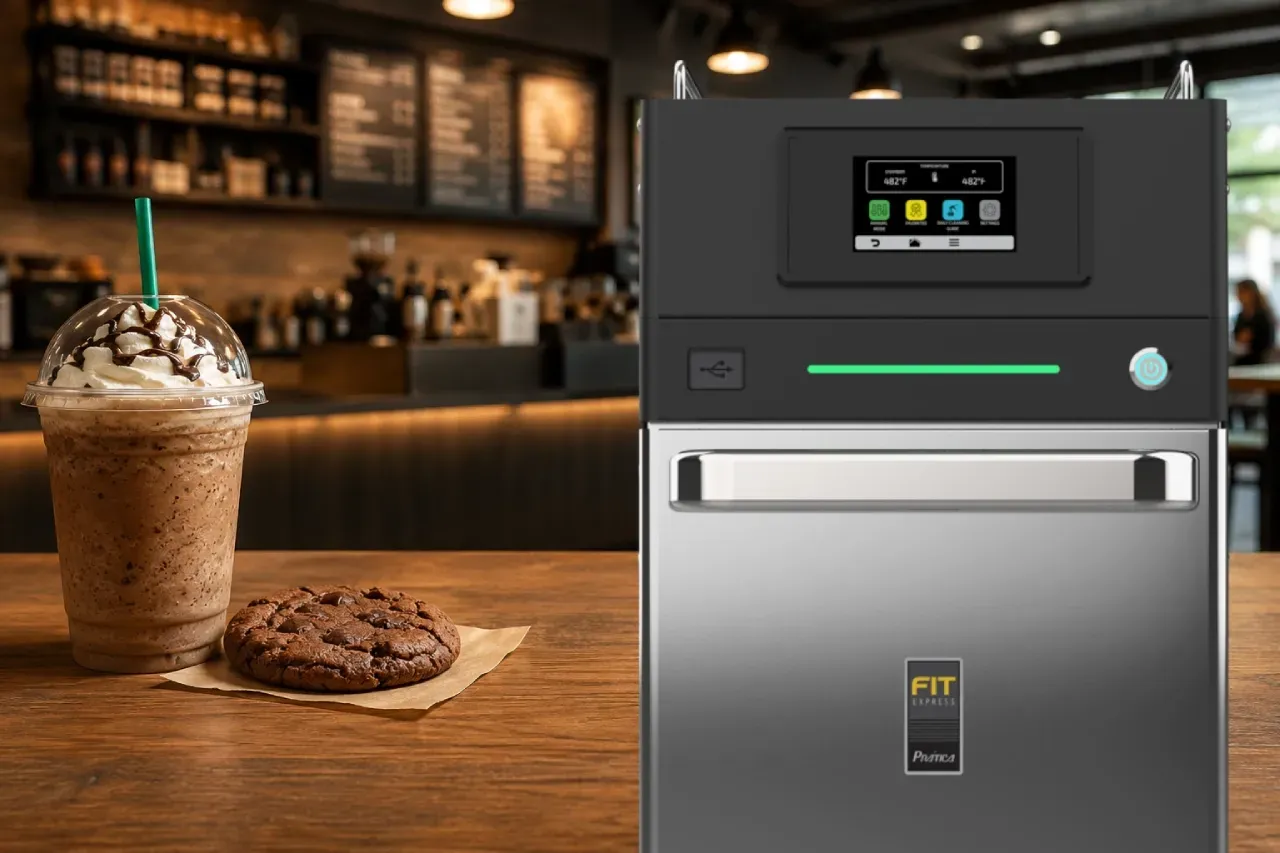
European cafeterias have evolved into dynamic foodservice businesses.
Alongside specialty coffee, customers now expect fresh breakfasts, toasted sandwiches, warm bakery products, pastries and grab-and-go meals prepared in just a few minutes.
Meeting these expectations can be challenging for cafés operating with limited kitchen space, small teams and high customer demand during breakfast and lunch.
At the same time, operators are looking for ways to expand their menu without increasing the number of appliances or redesigning their kitchen.
Accelerated cooking technology addresses these challenges by enabling fast regeneration, consistent results and flexible menu production within a compact footprint.
For coffee shops, bakery cafés and multi-site hospitality businesses, speed ovens have become an important part of creating efficient, scalable operations.
Why cafeterias need faster cooking solutions
Today's cafés serve far more than coffee.
A typical menu may include:
- Breakfast sandwiches
- Croissants
- Toasties
- Paninis
- Savoury bakery products
- Cakes
- Cookies
- Light lunches
- Grab-and-go meals
- Seasonal specials
Preparing this variety of products with traditional cooking equipment can create bottlenecks during peak demand, particularly when several orders arrive simultaneously.
Foodservice operators therefore need commercial cooking equipment capable of increasing service speed while maintaining product quality and production consistency.
Speed ovens help solve this challenge by combining multiple cooking technologies into a single appliance, allowing cafés to prepare a broad range of menu items without increasing kitchen complexity.
How accelerated cooking works
Unlike conventional commercial ovens, Speed Ovens use accelerated cooking technology that combines different heating methods to optimise both cooking performance and product quality.
Many professional models integrate:
- Convection cooking
- Microwave energy
- Air impingement technology
Each technology contributes differently to the cooking process.
Microwave energy rapidly heats to the centre of the product.
Convection circulates heated air throughout the oven cavity, promoting even heat distribution.
Air impingement directs high-velocity heated air onto the food surface.
By disrupting the thin insulating layer of cooler air surrounding the product, heat transfer becomes significantly more efficient.
This combination allows products to cook faster while delivering the browning and crisping that customers expect from freshly prepared bakery products, toasted sandwiches and premium café menus.
Instead of sacrificing quality for speed, accelerated cooking balances rapid preparation with consistent appearance, texture and flavour.
Why regeneration is transforming café operations
Regeneration is one of the most valuable applications of Speed Ovens.
Instead of preparing large quantities of food in advance and holding products in heated display cabinets for extended periods, cafés can refrigerate prepared items under appropriate storage conditions and regenerate them only when an order is placed.
This approach offers several operational advantages:
- Better holding quality before service
- Fresher finished products
- Lower food waste
- Improved inventory management
- Greater menu availability throughout the day
- Better food safety through controlled preparation procedures
Preparing products on demand also helps businesses maintain a consistently high standard of quality from the first order of the day to the last.
Increasing throughput during peak demand
Breakfast and lunchtime are often the busiest periods for coffee shops.
High customer volumes place pressure on both beverage preparation and kitchen production, making throughput one of the most important performance indicators for any café.
Accelerated cooking technology reduces preparation times, allowing operators to process more orders within the same period without increasing kitchen space.
Higher throughput contributes directly to:
- Faster service speed
- Shorter queues
- Improved customer flow
- Better kitchen capacity
- Greater production efficiency
Rather than expanding the kitchen or investing in multiple cooking appliances, businesses can often increase production capacity by improving how existing space is utilised.
Expanding the menu without expanding the kitchen
One of the biggest challenges facing independent cafés is introducing new menu items without overcrowding the kitchen.
Traditionally, menu expansion has required additional appliances such as grills, ovens or toasters.
Programmable Speed Ovens simplify this process by supporting multiple cooking applications within a single compact unit.
From breakfast menus to toasted sandwiches, pastries, desserts and grab-and-go products, operators can prepare a diverse range of menu items using recipe-specific cooking programmes.
Selecting the appropriate oven cavity is equally important.
Smaller cafés may benefit from compact oven cavities that maximise available workspace.
Higher-volume operations often require larger oven cavities capable of preparing multiple products simultaneously, increasing production capacity during busy trading periods.
Choosing the right cavity size helps businesses align equipment capacity with customer demand while avoiding unnecessary investment in oversized equipment.
Airflow management delivers consistent results
Different products require different cooking conditions.
Modern speed ovens allow operators to adjust airflow management according to the requirements of each recipe.
Delicate pastries, toasted sandwiches and bakery products all benefit from different airflow settings, helping optimise browning, crisping and overall product quality.
Recipe programmability also improves production consistency by reducing variation between operators.
For businesses operating multiple locations, consistent cooking programmes help standardise menu quality regardless of who is preparing the order.
Prática takes this one step further through its exclusive IoK (Internet of Kitchen) platform.
IoK allows operators to remotely distribute recipe updates, monitor equipment performance and manage cooking programmes across multiple locations, simplifying operational standardisation throughout the business.
Supporting food safety
Food safety remains a priority across every foodservice operation.
Preparing products on demand reduces the need for prolonged hot holding while helping operators follow consistent preparation procedures.
Combined with HACCP principles, temperature monitoring, allergen management, cleaning routines and correct refrigerated storage, accelerated cooking supports reliable food preparation from receiving through to service.
Choosing the right speed oven for a cafeteria
Selecting commercial cooking equipment involves more than comparing cooking times.
Operators should evaluate:
- Daily production volume
- Peak demand
- Oven cavity size
- Kitchen capacity
- Throughput requirements
- Menu expansion plans
- Airflow management
- Recipe programmability
- Production consistency
- Energy efficiency
- Ventless installation options, where applicable
Considering these factors helps businesses invest in equipment that supports both current operations and future growth.
Why speed ovens are becoming essential for modern cafeterias
Coffee shops continue expanding their menus while operating within the same physical footprint.
Accelerated cooking technology helps address this challenge by increasing throughput, supporting menu expansion, improving service speed and delivering consistent product quality without adding unnecessary kitchen complexity.
For independent cafés, bakery cafés and multi-site hospitality businesses, speed ovens provide a practical way to optimise kitchen capacity while supporting food safety, operational efficiency and a better customer experience.
Frequently asked questions
What is a speed oven?
A Speed Oven is a commercial cooking appliance that combines technologies such as convection, microwave and air impingement to prepare products significantly faster than conventional ovens while maintaining product quality.
Why is regeneration important in cafeterias?
Regeneration allows products to remain under refrigerated storage until needed, reducing hot holding time, supporting food safety and delivering fresher products on demand.
How does air impingement improve cooking?
Air impingement accelerates heat transfer by directing high-velocity heated air onto the product surface, helping achieve even browning and crisping in significantly less time.
How should a café choose the right oven cavity?
The ideal oven cavity depends on daily production volume, menu variety and peak demand.
Smaller operations often benefit from compact models, while higher-volume cafés may require larger cavities to increase throughput.
How do programmable recipes improve consistency?
Recipe programmability standardises cooking parameters for each menu item, reducing operator variation and helping maintain consistent quality across every service and location.
Can speed ovens help expand a café menu?
Yes. Their versatility allows cafés to introduce new menu items without investing in multiple specialised cooking appliances, making menu expansion easier in kitchens where space is limited.