




How to Program a Speed Oven Recipe
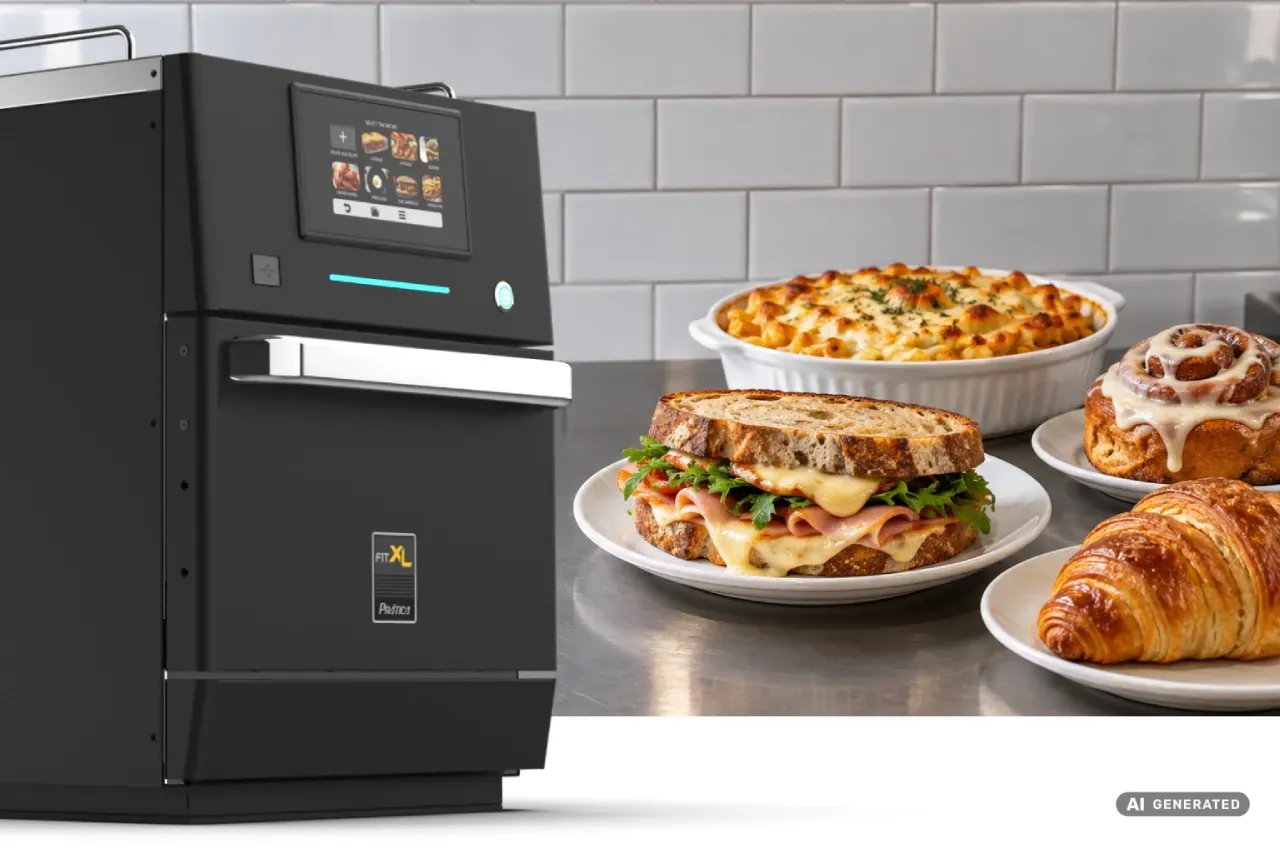
Programming a Speed Oven recipe starts with the food, not with the oven settings.
The product, portion, starting condition, container and required finish need to be defined before microwave power, hot air speed, temperature and time can be properly adjusted.
Effective Speed Oven programming is not simply about creating the shortest possible cycle.
The goal is to develop a programme that brings the food to the required internal temperature and finish while preserving its expected appearance, texture and overall quality.
Once that result has been tested and validated, the recipe can be saved for repeatable service.
What Is a Speed Oven Recipe?
Speed Oven recipe is a programmed cooking profile developed for a specific food and serving condition.
In the Prática FIT Express, each recipe can contain up to eight cooking steps.
Every step can have its own settings for:
- hot air speed;
- microwave percentage;
- temperature;
- time.
This allows cooking conditions to change as the product progresses through the cycle rather than applying the same parameters from beginning to end.
One stage may prioritise internal heating, for example, while another develops the required surface colour and crispness.
Start With the Food, Not the Settings
Before programming the oven, define what will actually be cooked.
Consider:
- product specification;
- portion size and weight;
- dimensions and thickness;
- starting condition;
- container;
- required internal temperature;
- surface or topping finish;
- expected texture and appearance.
he FIT Express technical material identifies food weight, size and shape as factors in total preparation time.
It also notes that changes in initial temperature, portion size, weight or cooking utensil can affect the final result.
A useful basis for testing is:
actual product + defined portion + starting condition + container + required finished standard
Two foods that look almost identical may still require different programmes.
Moisture, density, thickness, fat, sugar and other characteristics can change how they heat and finish.
Understand the Four Cooking Parameters
The FIT Express uses four main variables in each programmed step: microwave percentage, hot air speed, temperature and time.
These parameters work together. Recipe development is therefore about finding the appropriate balance rather than maximising any single setting.
For a deeper explanation of how the heating technologies interact, see The Principles of Cooking with a Speed Oven.
Microwave Power
Microwave energy plays an important role in heating the product internally.
The microwave percentage on the FIT Express should not simply be interpreted as conventional power output.
The manual gives the example of a one-minute step set to 50% microwave: microwave energy operates for 15 seconds, pauses for 15 seconds and repeats the sequence, resulting in 30 seconds of microwave application during that minute.
Food characteristics matter as well. Greater quantity, density and thickness can change the heating process.
During testing, review microwave application when the product is not heating as expected, particularly in the centre.
It should also be evaluated if the edges are becoming excessively dry or showing signs of overheating.
There is no universal microwave percentage for a sandwich, pizza, prepared meal or other food.
The appropriate setting is the one validated for the actual product.
To understand microwave percentages and duty cycles in greater detail, read Speed Oven Power Levels Explained.
Hot Air Speed
Hot air contributes to heat transfer and plays an important role in surface development.
On the FIT Express, hot air speed can be adjusted from 0% to 100%.
According to the technical manual, increasing air speed can increase colour development and surface moisture removal, contributing to greater crispness.
Review this parameter when the exterior is becoming darker than required or needs a different surface finish.
Higher airflow is not automatically better. A brioche bun, for example, can develop colour much faster than a harder-crusted sourdough bread.
Foods with higher sugar content may also colour rapidly under intense heat.
For more on airflow, colour and crispness, see How Speed Ovens Create Perfect Browning.
Temperature
emperature establishes the thermal environment in which the cooking profile takes place.
It should be evaluated together with microwave, airflow and time rather than treated as an isolated setting.
During testing, temperature becomes particularly relevant when the product overall is not reaching the required cooking conditions under the intended profile.
Time
Time determines how long the food is exposed to the programmed combination of microwave energy, hot air and temperature.
Adding time, however, is not a universal solution.
If the other parameters are poorly balanced, extending the cycle can increase drying, excessive browning or other defects without correcting the underlying problem.
When the product does not reach the required standard within the intended cycle, identify what is wrong before simply adding seconds.
Why Food Characteristics Matter
Weight, thickness, density, moisture, fat and sugar can all influence how a product behaves in a Speed Oven.
A thicker product may become more difficult to heat when additional thickness is accompanied by greater density.
Differences in moisture can also change the result even when two products have similar dimensions.
Surface composition matters too.
Products that develop colour quickly may require a different balance of hot air and time from foods that tolerate more intensive surface heating.
Visual similarity alone is therefore not enough to determine whether two products can use the same programme.
Why Use Multiple Cooking Steps?
The FIT Express allows up to eight steps, each with independent settings for microwave percentage, hot air speed, temperature and time.
Multi-stage programming is useful when the food requires different conditions as cooking progresses.
Larger portions can benefit from this approach when internal heating and surface finishing need to be managed at different points in the cycle.
Frozen foods provide another example.
The FIT Express manual recommends considering two or three stages for frozen products, beginning with conditions that support defrosting and later adjusting the process to achieve the required colour and crispness.
A frozen product will generally require a different profile from its chilled equivalent.
A first stage may focus on defrosting and internal heating before later stages develop the surface.
The purpose of multiple stages is not to make programming complex.
Use them when the food itself requires the cooking conditions to change.
Portion Size Can Require Another Recipe
A programme created for one portion should not automatically be assumed to perform identically with two.
Increasing the quantity changes the amount of food being heated and can require parameter adjustments. In recipe development, doubling the portion may justify testing a dedicated programme for two units.
Both total weight and thickness matter, particularly when increased thickness is accompanied by greater density.
The FIT Express documentation likewise identifies changes in portion size and weight as variables capable of producing a result outside the established standard.
The Container Is Part of the Recipe
Select the intended container during recipe development, not after the programme has been validated.
Consider its compatibility with the equipment, safety, capacity, dimensions, shape, presentation and suitability for microwave-assisted cooking where applicable.
Different materials interact differently with microwave energy, and the FIT Express manual notes that changing the cooking utensil can affect the finished product.
Always follow the manufacturer's requirements for suitable utensils.
The FIT Express manual, for example, warns against using plastic containers in this model because of the chamber's heating conditions.
If the container changes, test the recipe again before adopting the new combination for routine production.
Pre-Preparation Can Be Part of the Process
Not every product needs to enter the Speed Oven at the beginning of its complete preparation process.
For some full meals and larger portions, part of the preparation may take place beforehand, followed by appropriate controlled storage and final preparation in the Speed Oven.
In these applications, the programme should be developed around the condition in which the food actually enters the equipment.
Whatever pre-preparation process is selected becomes part of the product specification used to test and validate the recipe.
How to Develop a Speed Oven Recipe
Once the product and required result have been defined, programming becomes a controlled testing process.
- Define the finished-product standard.
- Standardise the portion and starting condition.
- Select the intended container.
- Establish the correct preheat condition.
- Set the initial microwave, hot air, temperature and time parameters.
- Cook the actual product.
- Evaluate internal heating and surface finish.
- Identify what is outside the required standard.
- Adjust the relevant parameter or parameters.
- Test again.
- Validate the final cooking profile.
- Save it for production.
Changing one variable at a time can make it easier to identify what affected the result, but this does not need to become an absolute rule.
If both internal heating and surface finishing are outside the required standard, two related parameters may need adjustment during the same test.
The important point is to make deliberate changes based on the previous result.
How Many Tests Should a Recipe Need?
In Prática's recipe development experience, two or three tests are often enough to determine whether a cooking profile is moving towards the required result.
If repeated adjustments still fail to bring the food close to the desired standard, the programme may not be the only variable that needs attention.
Ingredients, portion, cut, composition or presentation can sometimes be changed to improve how the product heats and finishes inside the oven.
Continuing to alter settings indefinitely may simply compensate for a product that is poorly configured for the intended preparation method.
Which Setting Should You Change?
Evaluate what happened during the previous test before changing the programme.
- Centre not heating properly: review microwave application in relation to portion, thickness, density and starting condition.
- Edges becoming excessively dry or overheated: review microwave, time and the overall cooking profile.
- Surface becoming darker than required: review hot air application and the conditions producing the surface finish.
- Product overall not reaching the required cooking conditions: evaluate temperature together with the other parameters.
- Required standards not reached within the expected cycle: reconsider time only after checking whether the other parameters are properly balanced.
This diagnostic approach is more useful than adding time after every unsuccessful test.
Use Manual Mode to Test New Recipes
The FIT Express provides a Manual Mode that can be used to test new recipes.
The user can define time, temperature, hot air speed and microwave, then execute the cooking test.
If the result is approved, those parameters can be copied into the recipe editing system.
The tested parameters can then be allocated to a new recipe in an existing group or used while creating a new group.
The user defines the recipe name and image, selects the step that will receive the parameters and can add further stages when necessary.
A useful development sequence is:
Define → Test → Evaluate → Adjust → Validate → Save
How to Program a Recipe on the FIT Express
Once the cooking profile has been tested, it can be saved as a recipe on the FIT Express.
- Open Settings and access Edit Recipes.
- Select the group where the recipe will be stored.
- Choose the option to create a new recipe.
- Enter the recipe name and select its image or icon.
- Open Edit Steps.
- Select the first cooking step.
- Set the hot air speed, microwave percentage, temperature and time.
- Add another step when the product requires different cooking conditions later in the cycle.
- Add an operator instruction when an action is required between steps.
- Test the programmed sequence with the actual food before approving it for service.
The FIT Express allows up to eight cooking steps, and each active step can have its own cooking parameters.
A step can also be disabled without being deleted.
If the recipe has already been developed in Manual Mode, the tested parameters can be copied into the recipe system rather than entered again from the beginning.
Match the Recipe to the Correct Preheat
Recipe testing should take place under the chamber conditions expected during service.
The FIT Express provides two preheat groups.
The manual uses breakfast or sandwich recipes and lunch or dinner recipes as examples of menus that may require different preheating temperatures.
Recipes associated with Preheat 1 are available with that selection, while those associated with Preheat 2 follow the second group.
The oven also provides a preheat time after reaching the programmed temperature.
This allows temperature to become uniform throughout the chamber and supports the performance of the first recipes of the operation.
Develop and validate the programme under the same preheat conditions expected in routine use.
Add Instructions Between Cooking Steps
Some recipes require an operator action before the next stage begins
.
The FIT Express allows information to be added to a step. During execution, the recipe can pause and display an instruction.
The example in the manual is “ADD TOMATOES.” Once the action is completed, the operator resumes the programme.
This allows the programmed recipe to include preparation actions as well as cooking parameters and can help different operators follow the same process.
Set Cook More and Brown More Carefully
The FIT Express provides finishing options that can be configured for individual recipes.
- Brown More uses hot air.
- Cook More uses microwave.
- Cook/Brown More provides additional cooking and browning.
Their duration can be set by recipe, and the options can be made available after the main cycle.
They are useful when an individual serving needs additional finishing.
If most servings routinely require extra cooking or browning, however, review the recipe or product conditions instead of relying on these functions as a permanent correction.
When Is a Recipe Ready for Service?
A recipe should be approved against defined food-quality criteria, not simply because the programmed cycle has ended.
Check:
- internal temperature;
- surface or topping finish;
- overall presentation;
- texture;
- excessive drying;
- burning;
- unwanted hardening;
- other visible or sensory defects.
A shorter cycle has little operational value if the product does not reach the required standard.
Once the food repeatedly reaches its intended internal and external conditions, the cooking profile can become the production recipe.
Organise Recipes for Daily Service
The FIT Express supports up to 16 groups.
Groups can have their own names and images and can be associated with the relevant preheat selection.
Individual recipes can also be named, assigned an image, arranged within the group and added to Favorites.
Organising the menu around the way the operation actually works, such as breakfast, sandwiches, pizza or bakery products, can make validated programmes easier for operators to find during service.
Transfer Recipes Between FIT Express Ovens
Once recipes have been developed and validated, the FIT Express can import and export information using USB.
Available functions include transferring all information, groups and recipes, or settings.
This can be useful when managing multiple compatible ovens because established recipe structures do not need to be recreated manually on each unit.
There is an important precaution: according to the FIT Express manual, importing groups, recipes or settings replaces the corresponding information already stored in the oven.
Existing information should therefore be considered before performing an import.
Programming or Troubleshooting?
Recipe programming and troubleshooting address different situations.
During programming, you are developing or validating a cooking profile for a defined product.
During troubleshooting, a previously validated recipe is no longer producing the expected result.
In the second situation, do not immediately rewrite the programme.
First verify whether the portion, starting condition, container, load or other product and operating conditions have changed.
For that diagnostic process, read Speed Oven Troubleshooting: Common Cooking Problems.
Frequently Asked Questions
What settings should I use for a Speed Oven recipe?
There is no universal combination of microwave, hot air, temperature and time for every food.
Settings should be developed using the actual product, defined portion, starting condition, container and required finished result.
What does microwave percentage mean on a Speed Oven?
On the FIT Express, microwave percentage controls its application during the programmed period.
The manual's example shows that a one-minute stage at 50% applies microwave energy for a total of 30 seconds through alternating operating and pause periods.
How many stages can a FIT Express recipe have?
A FIT Express recipe can contain up to eight steps. Each can have its own hot air speed, microwave percentage, temperature and time.
How many tests are needed to develop a Speed Oven recipe?
In Prática's recipe development experience, two or three tests are often enough to determine whether the cooking profile is progressing towards the desired result.
If repeated changes still fail to produce an acceptable result, the food specification itself may need to be reconsidered.
Can I use the same programme for frozen and chilled food?
Do not assume so.
Starting temperature affects the cooking result, and frozen food may require a different balance of microwave, time and cooking stages from its chilled equivalent.
Do I need a different recipe for two portions?
Possibly. A programme developed for one portion should be tested again when the quantity changes significantly.
Doubling the portion can require parameter adjustments and may justify a dedicated programme for two units.
Build the Programme Around the Product
Successful Speed Oven programming begins with a defined food standard.
Establish the product, portion, starting condition, container and required result.
Then use microwave, hot air, temperature, time and, when necessary, multiple cooking stages to build the programme around those conditions.
Test the actual food and make deliberate adjustments based on the result.
If repeated tests cannot achieve the expected standard, reconsider the product specification rather than continually compensating with oven settings.
Once the food and cooking profile have both been validated, the saved recipe gives operators a defined process to reproduce during service.
Starting temperature can change how a recipe performs.
Learn why chilled and frozen foods require different approaches in From Cold to Ready: Why Chilled Means Faster Service.