




How to Make Panini Faster with Speed Ovens
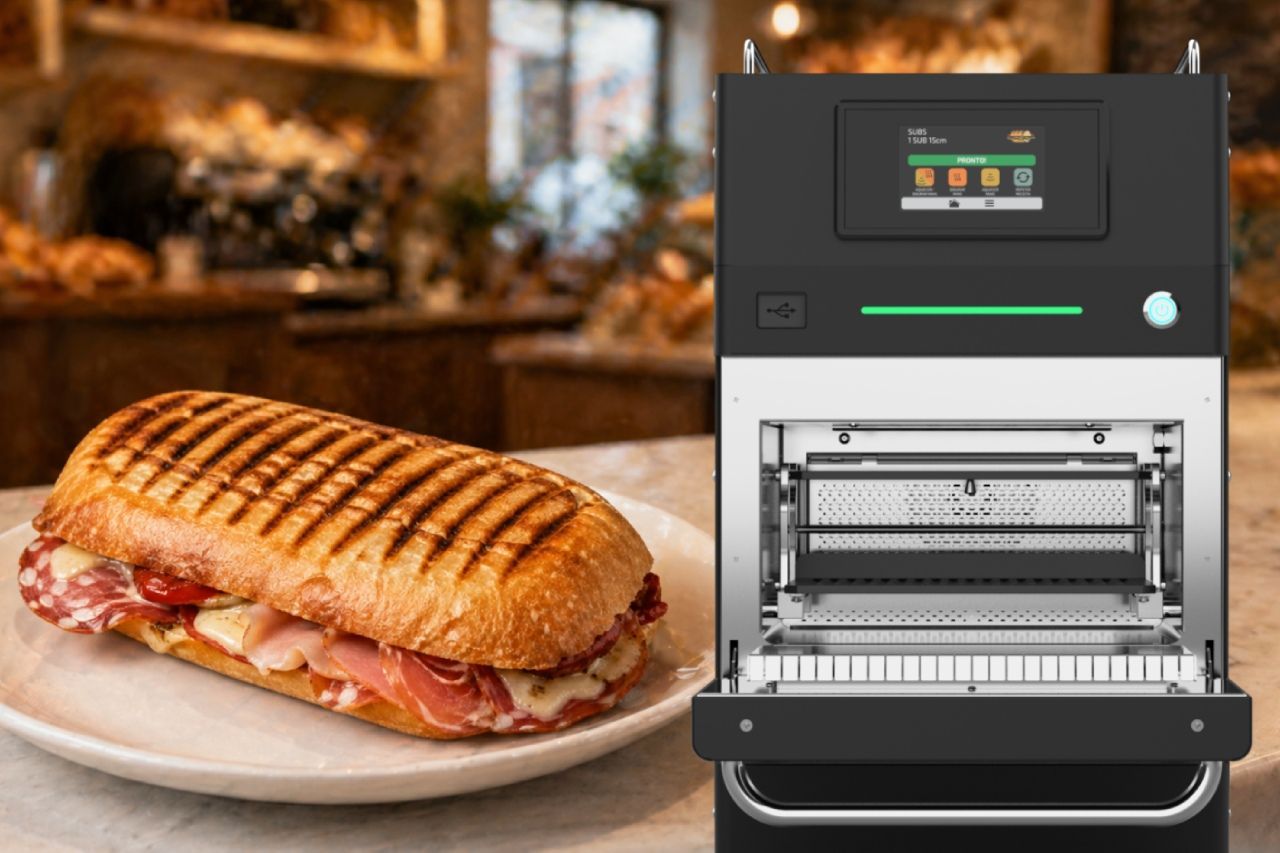
Panini are widely present in bakeries, cafés and food-to-go operations, recognised as a versatile sandwich category valued for speed, flexibility and ease of preparation in foodservice.
Italian origin and culinary foundation
Rooted in Italian culinary culture, the panino reflects a simple yet effective concept: high-quality bread such as ciabatta or focaccia combined with carefully selected ingredients, prepared quickly and served fresh.
Terminology and usage across markets
In Italian, “panino” refers to a single sandwich, while “panini” is the plural form.
Across Europe, however, the term “panini” is commonly used to define a category of sandwiches prepared in this style, associated with pressed bread, warm fillings and fast service.
This broader usage reflects how the concept has evolved beyond its linguistic origin into a recognised product segment in foodservice.
Bread structure and product quality
The structure of the bread plays a central role in the final result.
Artisan breads with a defined crust and open crumb allow heat to penetrate efficiently while maintaining the contrast between a crispy exterior and a soft interior with melted fillings.
Panini in Italian daily life
In Italy, panini are part of everyday consumption. They are commonly found in cafés, bars and paninoteche, often assembled with minimal processing.
The focus is on ingredient quality, balance and convenience, making them suitable for quick meals throughout the day.
Adaptation across Europe
As this concept expanded across Europe, panini adapted to different consumption habits.
Pressed and heated versions became increasingly common, offering a golden finish, defined crust and a consistent contrast in texture suited to high-demand urban environments and grab-and-go formats.
Why panini fit modern food-to-go operations
The growth of food-to-go across Europe has increased demand for products that combine speed, flexibility and consistency.
Panini respond directly to these requirements.
They can be prepared and served in minutes, supporting high turnover during peak periods such as breakfast, lunch and afternoon service.
In high-demand environments, they can be finished in seconds when using advanced equipment, enabling higher throughput and on-demand preparation.
Their structure allows a wide range of combinations using proteins, cheeses, vegetables and sauces.
This supports the development of hot sandwich menus, including breakfast panini and deli-style options, without increasing operational complexity.
Panini also fit compact environments.
They can be produced in small kitchens, kiosks, deli counters or front-of-house areas, where space is limited and workflow efficiency is essential.
Consistency is another key factor. Standardised assembly and finishing ensure that each unit delivered meets the same expectations, which is critical for multi-site operations and brand reliability, while also supporting visual consistency in display.
The role of heating and finishing
Achieving the ideal panini depends on two technical results: a crispy exterior and evenly heated fillings.
Traditional equipment such as contact grills or conventional panini presses can deliver these outcomes, but often with limitations.
Preparation time may be longer, results can vary between operators, and performance depends heavily on manual control.
In high-volume environments, these factors can affect service speed optimisation and overall efficiency.
Compared to solutions such as convection ovens or microwave-only heating, achieving both speed and texture simultaneously becomes more challenging without a combined heating approach.
For businesses aiming to scale or streamline operations, a faster, more controlled and repeatable process becomes necessary.
Speed Ovens as a modern solution
Speed Ovens combine microwave energy with impinged air to heat and finish products simultaneously.
This allows the interior of the panini to reach the desired temperature quickly, while the exterior develops a crisp, golden finish.
In practical terms, a panini that would traditionally take several minutes on a grill can be ready in seconds.
This has a direct impact on service flow, particularly during peak hours, where faster preparation increases throughput, reduces waiting time and improves overall efficiency.
Consistency is achieved through programmable recipes.
Each cycle follows defined parameters, ensuring uniform results regardless of the operator or location.
This is especially relevant for chain operations or businesses managing multiple points of sale.
Labour dependency is reduced, as the process requires limited manual intervention.
This simplifies training and supports teams with different levels of experience.
Front-of-house preparation and on-demand service
The compact and ventless design of Speed Ovens allows installation close to the service area.
This enables front-of-house production, where panini can be prepared in view of the customer, enhancing visual appeal, supporting faster decisions and encouraging impulse purchases.
In a typical bakery setting, chilled panini can be assembled in advance and stored under controlled conditions, then finished on demand.
During peak periods, staff can consistently deliver a hot product in seconds without relying on traditional grills or larger kitchen structures.
Enhancing results with the Panini Press accessory
To complement this process, the Panini Press accessory adds visual definition and controlled pressure during preparation.
Developed for Prática’s FIT Express, FIT SM and FIT ST models, it enables the creation of panini with uniform grill marks and consistent structure.
This visual element contributes directly to customer perception, especially in front-of-house environments where presentation influences purchasing decisions.
The accessory applies pressure between top and bottom plates, improving contact between bread and heat.
This contributes to a crisp crust while maintaining a properly heated interior with melted fillings.
Operational use is straightforward.
A dedicated paddle allows safe positioning of the product and controlled opening and closing during the cycle.
The adjustable opening range accommodates different product sizes, from classic panini to larger sandwiches.
It can remain inside the oven cavity when not in use, allowing operators to switch between menu items without interrupting workflow.
The non-stick surface supports frequent use and simplifies cleaning in high-volume operations.
A bridge between tradition and modern operations
Panini connect culinary heritage with contemporary foodservice demands.
Originating from a culture that values simplicity and ingredient quality, they have evolved into a versatile product aligned with fast service formats across foodservice worldwide.
By integrating Speed Ovens with the Panini Press accessory, operators can produce this category of sandwiches with greater speed, consistency and control.
This approach supports efficient use of space, predictable output and reliable product delivery.
For bakeries, cafés and food-to-go businesses, panini represent a practical opportunity to expand menus, optimise service time and increase throughput while maintaining the expected quality standard and visual appeal expected in modern European foodservice.
Explore how Speed Ovens help reduce food waste by finishing products on demand, avoiding prolonged exposure in display counters.