




High Speed Ovens in Digital Foodservice
Digital transformation is no longer limited to online ordering or digital menus.
In European foodservice, it now reaches the core of operations, from financial control to food preparation itself.
Beyond front of house applications, back office software for financial management, stock control and workforce scheduling is widely adopted.
These systems reduce manual tasks, centralise data and offer a consolidated view of business performance.
Today, digital oversight goes deep into the kitchen, influencing not only storage and procurement, but also how food is prepared, finished and served.
At the same time, market reports point to steady growth in connected equipment with integrated digital capabilities.
IoT enabled ovens, intelligent refrigeration and advanced automated washing systems are becoming standard in modern kitchens.
The focus is clear: operational efficiency, energy optimisation and food safety.
Technologies Knocking on Your Doorstep
Across Europe, operators are investing in integrated POS systems, inventory management platforms and real time analytics.
These tools improve stock accuracy, demand forecasting and order precision. They also create new expectations for speed and consistency.
Traditional stove and pan operations now face increasing pressure.
When orders arrive simultaneously from in store, click and collect and delivery channels, manual processes struggle to keep pace.
As a result, kitchens are turning to modern cooking technologies that combine speed, control and repeatability.
Among these solutions, Speed Ovens stand out.
They heat, finish, brown, toast and crisp products in a fraction of the time required by conventional equipment.
For customers who expect rapid service without compromising quality, this combination is decisive.
Speed Ovens align naturally with this evolution.
Programmable recipes, controlled power levels and consistent heat distribution reduce dependency on highly specialised labour.
Even less experienced operators can deliver standardised results across shifts and locations.
Connected Smart Equipment and IoK Integration
The integration of IoT devices in commercial kitchens enables remote monitoring, preventive maintenance and energy management.
Connected equipment also supports standardisation across multiple units, a critical requirement for chains and franchise models.
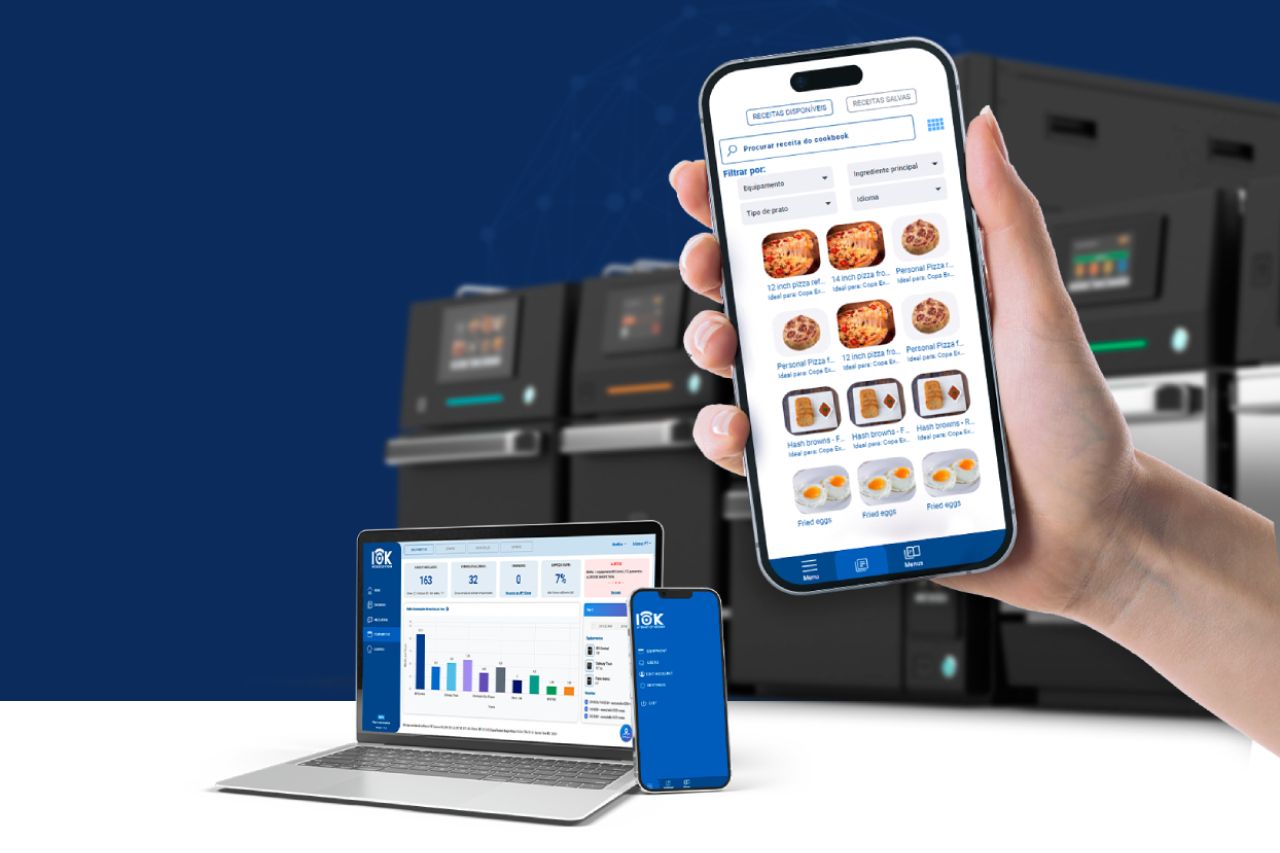
Prática’s Speed Ovens connect to the exclusive IoK platform, Internet of Kitchen.
Through IoK, operators can manage recipes, update menus and monitor oven data remotely from a mobile device, tablet or desktop.
Years ago, launching the same product in two different stores required a senior professional to travel between locations, adjust parameters and train teams in person.
With connected ovens, recipes can be uploaded centrally and deployed instantly across multiple sites.
This reduces implementation time and ensures operational alignment.
For businesses expanding across cities or countries, this level of control is no longer optional. It is operational infrastructure.
Cloud Kitchens and Space Efficiency
Cloud kitchens continue to expand in Europe, driven by delivery demand and urban density.
These digital first models operate with limited space and high order volumes. Every square metre counts.
Large traditional equipment can create installation challenges, especially where ventilation, heat dissipation and energy supply are constrained.
Compact, high output equipment becomes essential.
Prática’s High Speed Ovens respond directly to these conditions.
Their compact footprint, ventless design and rapid cooking cycles support high throughput without excessive heat release into the workspace.
For operators balancing space limitations with growth targets, this combination is highly relevant.
Data as a Competitive Advantage
Predictive analytics and data intelligence tools are transforming menu engineering and operational planning.
By analysing peak hours, product performance and purchasing patterns, operators can refine pricing, adjust production volumes and align staffing with demand.
Equipment capable of integrating with these digital ecosystems represents a forward looking investment.
When oven usage data, sales data and customer behaviour metrics converge, decision making becomes e
vidence based rather than intuitive.
Imagine correlating product popularity with oven cycles, preparation times and peak demand windows.
This mirrors the data driven logic used by major digital marketplaces, now applied within the kitchen itself.
Digitalisation in Daily Practice
Self service kiosks, digital menu boards and mobile ordering applications are increasingly common.
They reduce queues and streamline service flow. However, technology does not eliminate the human factor. It enhances it.
Automated equipment enables teams with varying skill levels to deliver consistent quality.
Touchscreen interfaces, product icons and pre programmed recipes simplify daily operation.
Prática’s Speed Ovens feature intuitive touchscreen controls organised by product groups and recipes.
Interfaces can be customised with real product images, facilitating use by operators.
Cleaning procedures are guided step by step on screen, supporting proper maintenance and food safety compliance.
Through IoK, recipe management in the cloud eliminates the need for a senior technician to be physically present for updates.
This flexibility supports agile menu development and faster market response.
Faster Service, Higher Customer Satisfaction
Customer expectations in European foodservice are increasingly shaped by speed and digital convenience.
A strong brand concept can quickly lose appeal if service is slow, inconsistent or disorganised.
High Speed Ovens contribute directly to faster service without compromising quality.
Reduced preparation time shortens queues and improves workflow.
Standardised cycles prevent product variation across shifts or locations.
In competitive urban markets, response time is closely linked to customer retention.
Waste Reduction and Quality Preservation
Food waste remains a significant financial and ethical challenge.
Perishable ingredients deteriorate quickly, and products prepared in advance may lose texture, aroma and visual appeal.
Operational models that separate preparation from final finishing can reduce waste while preserving quality.
Speed Ovens support this approach effectively.
Products can be pre prepared, stored under controlled conditions and finished on demand at the point of sale.
Finishing at the moment of consumption enhances organoleptic characteristics such as crispness and aroma.
Instead of remaining exposed in display cabinets, items reach the customer freshly finished.
This model not only improves profitability but also aligns with responsible resource management and food safety standards.
Automation and AI in Professional Kitchens
Automation and artificial intelligence are moving steadily towards becoming a structural feature of professional kitchens across Europe.
What may still seem experimental today is increasingly feasible, scalable and commercially realistic.
Robotics, AI based tools and predictive algorithms are gaining ground, not as futuristic concepts, but as operational solutions under evaluation by forward looking operators.
Over the coming years, these systems are expected to adjust time and temperature parameters automatically based on real time data, improving consistency, supporting food safety and reducing waste.
As labour shortages and cost pressures remain persistent across the sector, technology adoption is likely to accelerate.
Businesses that delay modernisation may find themselves reacting under pressure rather than evolving with control.
Adopting automation gradually allows teams to adapt processes step by step.
It enables testing, calibration and cultural alignment within the organisation.
Instead of abrupt transformation, operators can build a digitally supported kitchen environment that balances human expertise with intelligent systems.
In this context, AI and automation should not be seen as replacing professionals, but as tools that enhance precision, standardisation and operational resilience.
For many European foodservice businesses, this shift is not a distant possibility.
It is an emerging and plausible direction for the near future.
A Structural Shift in Kitchen Operations
Digital transformation in European foodservice is structural rather than temporary.
It affects how businesses plan, produce, serve and analyse performance.
Operators who integrate connected equipment, data intelligence and controlled cooking technologies create operations that are measurable, scalable and resilient.
In this landscape, Speed Ovens are not merely fast cooking devices.
They are operational assets that connect performance, consistency and digital management in a single platform.
For entrepreneurs and professional teams across Europe, the question is no longer whether digital transformation will reach the kitchen. It already has.